Recently in Legislation Category

By Martin Walker
July 8, 2010

The sinister Skeptics group, agents of what used to be CSICOP now the Committee for Skeptical Inquiry (CSI) organised from the US and linked to the major corporate lobby groups, American Council on Science and Health (ACSH) and American and the Australian Council Against Health Fraud (ACAHF) are making ground in Australia.

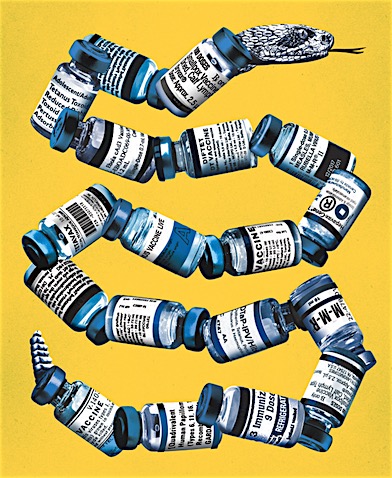
Supported by authoritarian ideological influences in government and Big Pharma, the Skeptics are running constant attacks on homeopathy, natural cancer treatments, those who question vaccination and those who support any form of alternative medicine.

With the present world fiscal crisis, all those linked to Big Pharma and Science are fighting a bitter battle to preserve drug company competitiveness. But where fascist influences in government and health with most force come together is in attacking anyone who speaks out about freedom of choice and expression in relation to vaccination.

Over the last year the international corporate lobby Skeptics, have been behind a campaign against the Australian Vaccination Network (AVN). In 2009, one of their trolls, a lay person with no standing in medicine or government complained about the web site of the AVN to the office of the State Government funded Health Care Complaints commission (HCCC) an organisation that accepts complaints against groups found be giving out false information about health.

  • Currently 2.1/5
  • 1
  • 2
  • 3
  • 4
  • 5
Rating: 2.1/5 (30 votes cast)

Natural News
June 11, 2010
By Mike Adams

(NaturalNews) After weeks of silence on the issue, the U.S. Environmental Protection Agency (EPA) finally decided to go public with the list of ingredients used to manufacture Corexit, the chemical dispersant used by BP in the Gulf of Mexico oil disaster. There are two things about this announcement that deserve our attention: First, the ingredients that have been disclosed are extremely toxic, and second, why did the EPA protect the oil industry's "trade secrets" for so long by refusing to disclose these ingredients until now?

As reported in the New York Times, Brian Turnbaugh, a policy analyst at OMB Watch said, "EPA had the authority to act all along; its decision to now disclose the ingredients demonstrates this. Yet it took a public outcry and weeks of complaints for the agency to act and place the public's interest ahead of corporate interests."

  • Currently 2.3/5
  • 1
  • 2
  • 3
  • 4
  • 5
Rating: 2.3/5 (3 votes cast)

VOICE

Posted on 25 Mar 2010 - by In: Stop Fluoridation

Press Release, Dublin The risks to children exposed to fluoridated Irish water are highlighted in a scientific review just published in the peer-reviewed journalToxicology [1]. It adds more weight to the call by the report of the Oireachtas Joint Health Committee in 2007 (www.fluoridereports.com) to stop fluoridation to protect children from the irreversible damage to tooth enamel by dental fluorosis.

Study author and scientific director of the Alliance for Natural Health(www.anhcampaign.org) Dr Robert Verkerk, argues that if the same methods used by European and American authorities for risk assessment of vitamins and minerals are applied to fluoride, then fluoridation of the water supply would need to be banned due to the high risk of dental fluorosis in children. Said Dr Verkerk "Under current risk management criteria, the dental fluorosis risk to children, which is the most sensitive risk factor, should mean that mass fluoridation of the public water supply is stopped immediately. This is borne out by actual data from Ireland which shows that every third child is affected".

  • Currently 3.7/5
  • 1
  • 2
  • 3
  • 4
  • 5
Rating: 3.7/5 (3 votes cast)

NewsWithViews.com
By Attorney Jonathan Emord
June 3, 2010


On May 27, 2010, the Honorable Ellen Segal Huvelle of the United States District Court for the District of Columbia held that FDA violated the First Amendment when it variously censored and saddled with lengthy and inaccurate disclaimers ten health claims associating the essential nutrient selenium with a reduction in the risk of certain kinds of cancer. The decision (Alliance for Natural Health v. Sebelius) is momentous. It upsets a plan underway within the Commission to undermine and disavow compliance with the final and binding orders of the United States Court of Appeals in Pearson v. Shalala, a plan fully in accord with the wishes of that dedicated fan of unlimited government, Congressman Henry Waxman.

I have had the privilege of representing the plaintiffs in the Pearson cases, including the present one, Alliance for Natural Health v. Sebelius, holding FDA censorship of selenium claims unconstitutional. In the landmark Pearson v. Shalala case, the FDA's censorship of four nutrient-disease relationship claims (including ones associating antioxidant vitamins with cancer risk reduction; folic acid with neural tube defect risk reduction; fiber with colorectal cancer risk reduction; and omega-3 fatty acids with coronary heart disease risk reduction) was held unconstitutional under the First Amendment.

  • Currently 3.5/5
  • 1
  • 2
  • 3
  • 4
  • 5
Rating: 3.5/5 (4 votes cast)

The one click group
May 4th, 2010
  the raw story
US school for disabled forces students to wear packs that deliver massive electric shocks
By Diana Sweet

201005071429.jpg

Mental Disability Rights International (MDRI) has filed a report and urgent appeal with the United Nations Special Rapporteur on Torture alleging that the Judge Rotenberg Center for the disabled, located in Massachusetts, violates the UN Convention against Torture.

The rights group submitted their report this week, titled "Torture not Treatment: Electric Shock and Long-Term Restraint in the United States on Children and Adults with Disabilities at the Judge Rotenberg Center," after an in-depth investigation revealed use of restraint boards, isolation, food deprivation and electric shocks in efforts to control the behaviors of its disabled and emotionally troubled students.

  • Currently 5/5
  • 1
  • 2
  • 3
  • 4
  • 5
Rating: 5/5 (3 votes cast)

News with Views

By Sarah Foster
May 4, 2010


201005041425.jpg

WASHINGTON - Last week and over the weekend, the Internet was buzzing about a heretofore undetected provision Rep. Henry Waxman, D-Calif., had slipped into the Wall Street financial reform bill that the House passed in December - a provision critics warned could devastate the nutritional supplement industry with excessive regulations, driving up the costs of supplements or removing them from the market altogether.

"The Wall Street Reform and Consumer Protection Act of 2009 (H.R. 4173) ...includes language going far beyond finance," the Alliance for Natural Health-USA, a D.C.-based health freedom advocacy group, stated in an April 27 report, with the warning: "This language could be used for an end run around the Dietary Supplement Health and Safety Act (DSHEA), the legislation that governs dietary supplement regulation by the FDA."

  • Currently 4/5
  • 1
  • 2
  • 3
  • 4
  • 5
Rating: 4/5 (2 votes cast)

EFSA evaluates the safety of stevia

| | Comments (0)

EFSA evaluates the safety of steviol glycosides

The European Food Safety Authority’s scientific Panel on additives, the ANS Panel, has assessed the safety of steviol glycosides, sweeteners extracted from plant leaves, and established an Acceptable Daily Intake for their safe use. The assessment has been sent to the European Commission which will consider whether or not to authorise the substances in the European Union for their proposed use in particular in sugar free or reduced energy foods such as certain flavoured drinks, confectionery with no added sugar or energy reduced soups.

  • Currently 3/5
  • 1
  • 2
  • 3
  • 4
  • 5
Rating: 3/5 (3 votes cast)

Jim Riddle
Rodale Institute
April 12, 2010

201004161202.jpg

Despite fundamental differences in what they represent, there are occasional calls to allow the use of genetic engineering (which produces genetically modified organisms, known as GMOs) within the USDA National Organic Program. GMO varieties are currently most widespread in corn, soybean, canola and cotton crops, in dairy production, and in minor ingredients, such as dairy cultures, used in food processing, but new products are being introduced and commercialized.

  • Currently 0/5
  • 1
  • 2
  • 3
  • 4
  • 5
Rating: 0/5 (0 votes cast)

Institute of Science in Society

AVAAZ.org

GM FOOD: FACTS NOT CROPS

The European Commission has just approved growing genetically modified crops for the first time in 12 years, putting the GM lobby's profits over public concerns - 60% of Europeans feel we need more information before growing foods that could threaten our health and environment.

A new initiative allows 1 million EU citizens a unique chance to make official requests of the European Commission. Let's build a million voices for a ban on GM foods until the research is done. Sign the petition below and spread the word.

Don't forget to include your address so that all of our signatures count for the citizens' initiative.

http://www.avaaz.org/en/eu_health_and_biodiversity/98.php?CLICK_TF_TRACK

To the President of the European Commission José Manuel Barroso: We call on you to put a moratorium on the introduction of GM crops into Europe and set up an independent, ethical, scientific body to research the impact of GM crops and determine regulation.

  • Currently 5/5
  • 1
  • 2
  • 3
  • 4
  • 5
Rating: 5/5 (2 votes cast)

IMVA

International Medical Veritas Association

March 19, 2010

Confronting the Dark Side of Medicine

201003221530.jpg
Modern medicine in the United States today is putting
people in their graves in large numbers but before it
does the system is increasingly beating them into bankruptcy.

Not everyone is able to look at the dark side of them selves, and doctors are no exception in this regard. But without such a journey it is almost impossible to fully understand the darkest side of humanity being expressed in the world of medicine. Most people in fact actively avoid looking at their own weaknesses and negativity and find no problem with pointing the finger elsewhere. Many would have us concentrate only on the positive, hoping that the bad guys would stop doing harm and just go away. Unfortunately the unlooked at dark side has the bad habit of hitting us from behind, blindsiding us to the point of extinguishing our lives.

The medical establishment attacks people with sometimes lethal drugs and vaccines and condones dentists who continue to put mercury toxic waste dumps in people's mouths. Death by Medicine is not uncommon these days and the healthcare reform bill in the United States does nothing to address the western medical system seems to butcher more people than it helps.

  • Currently 5/5
  • 1
  • 2
  • 3
  • 4
  • 5
Rating: 5/5 (2 votes cast)

Census is for counting not prying

| | Comments (0)

By Chuck Baldwin

March 19, 2010

NewsWithViews.com

The constitutional requirement for the Census is found in Article. I. Section. 2. Paragraph. 3. "The actual Enumeration shall be made within three Years after the first Meeting of the Congress of the United States, and within every subsequent Term of ten Years, in such Manner as they shall by Law direct."

The purpose of the Census is that of counting the US population in order to apportion among the states the number of representatives in the US House of Representatives. That's it. Nothing more. Nothing less.

There is nothing in the Constitution requiring or even suggesting questions regarding race, ethnicity, whether one owns or rents his or her home, income status, disability status, education, or anything of the sort. The only purpose of the Census is to count the US population. Anything beyond that is nothing more than an intrusive government prying and snooping into our lives: something the federal government is doing with greater and greater frequency and intensity these days.

  • Currently 0/5
  • 1
  • 2
  • 3
  • 4
  • 5
Rating: 0/5 (0 votes cast)

February 2010 - Bolivia has challenged, during the World Trade Organization (WTO) negotiations of the Council for Trade-Related Aspects of Intellectual Property Rights (TRIPS), the prevailing philosophy of the patentability of life forms.


LaPazBolivia.jpg

Bolivia's capital city La Paz - by Sepp


The purpose of the ongoing negotiations is reviewing Article 27.3(b) of the TRIPS agreement, which states:

"Members may also exclude from patentability: plants and animals other than micro-organisms, and essentially biological processes for the production of plants or animals other than non-biological and microbiological processes. However, Members shall provide for the protection of plant varieties either by patents or by an effective sui generis system or by any combination thereof. The provisions of this subparagraph shall be reviewed four years after the date of entry into force of the WTO Agreement."

The patenting of life forms has brought serious problems, especially for farmers (see the case of Monsanto against Schmeiser for violation of its patent on genetically modified canola seeds) and for the biological resources of whole countries who find that all of a sudden, their herbs and traditionally used seeds varieties may have been patented by a multinational corporation to exclusively exploit, leaving the country or culture of origin high and dry. An apt expression that has been coined for this kind of theft is "biopiracy". According to an article in Wikipedia, "Biopiracy is a term used to describe situations where corporations from the developed world claim ownership of, or otherwise take unfair advantage of, the genetic resources and traditional knowledge and technologies of developing countries."

So one might applaud the Bolivians for taking up the issue of the patentability of life as part of the ongoing review of the TRIPS agreement. Here are some excerpts of the arguments in their lengthy submission:

  • Currently 5/5
  • 1
  • 2
  • 3
  • 4
  • 5
Rating: 5/5 (2 votes cast)

NaturalNews.com

March 15, 2010

by: Ethan Huff, citizen journalist

(NaturalNews) With hundreds of thousands of people dying every year from the side effects of pharmaceutical drugs, one would imagine that the U.S. Food and Drug Administration (FDA) would be out in full force pulling these drugs from the market, right? Actually, the agency has recently been spending its time targeting a walnut manufacturer for making legitimate, scientifically-proven health claims about walnuts on its packaging.

Such behavior is nothing new for the rogue agency that spends all of its time ridding the market of natural products, legitimate health claims on food, and other important products and information that actually help people become healthy rather than remain disease-stricken pharmaceutical drug addicts. In the case of walnuts, though, the vast amount of studies concerning the numerous benefits of the nut makes the FDA's mission to stop all purveyance of this information utterly incomprehensible.

  • Currently 0/5
  • 1
  • 2
  • 3
  • 4
  • 5
Rating: 0/5 (0 votes cast)


from ANH Update on Traditional Herbal Medicines in Europe

When the Traditional Herbal Medicinal Products Directive was passed in 2004, many herbal producers, including those producing herbs for the great and ancient traditions of Ayurveda and Traditional Chinese Medicine, saw the Directive as a 'godsend'.

Here was a piece of law that would give these herbal products a proper medicinal classification, meaning they could actually be used to help make sick people healthier. The food supplements regime, under which most of these products have been sold in Europe, of course doesn't allow any claim to be made about the treatment or protection against disease. In fact, food supplements are intended only for healthy persons (so they say)!

We are now 6 years into the implementation of the Directive, and only there's only a year before it's all-important transition phase runs out.

The American Botanical Council approached the ANH with three questions, asking its views on this issue that is of great importance to natural health, especially in the European Union. But obviously it has a major impact on suppliers from all around the world, and given the way in which European regulatory models are viewed in other regions, the practical workability of the system is crucial if it's going to be adopted elsewhere.

Here's what we had to say in response to the questions (in bold text) from the American Botanical Council...

continue reading at ANH Update on Traditional Herbal Medicines in Europe

  • Currently 0/5
  • 1
  • 2
  • 3
  • 4
  • 5
Rating: 0/5 (0 votes cast)

AN EXCLUSIVE INTERVIEW WITH
DR. BARBARA STARFIELD:
By Jon Rappoport
www.insolutions.info
www.nomorefakenews.com

On July 26, 2000, the US medical community received a titanic shock to the system, when one of its most respected and honored public-health experts, Dr. Barbara Starfield, revealed her findings on healthcare in America.

The landmark Starfield study, “Is US health really the best in the world?”, published in the Journal of the American Medical Association, came to the following conclusions:

Every year in the US there are:

12,000 deaths from unnecessary surgeries;

7,000 deaths from medication errors in hospitals;

20,000 deaths from other errors in hospitals;

80,000 deaths from infections acquired in hospitals;

106,000 deaths from FDA-approved correctly prescribed medicines.

The total of medically-caused deaths in the US every year is 225,000.

This makes the medical system the third leading cause of death in the US, behind heart disease and cancer.

  • Currently 4.5/5
  • 1
  • 2
  • 3
  • 4
  • 5
Rating: 4.5/5 (4 votes cast)

The Irish have been asked - for a second time - to approve in a referendum the treaty that makes deep changes in the contract of the European Union. The votes are counted, and the "yes" campaign was successful. But there are some serious questions how the referendum and especially the campaign leading up to the vote was conducted.

Anthony Coughlan of the National Platform EU Research and Information in Dublin, Ireland, has written to Mr Justice Clarke, the head of the Irish Referendum Commission, pointing out some of those inconsistencies...

- - -

  • Currently 5/5
  • 1
  • 2
  • 3
  • 4
  • 5
Rating: 5/5 (4 votes cast)

We urge Irish voters to say "NO" to Lisbon Treaty

| | Comments (1)

PRESS RELEASE: International Alliance of Non-Governmental Organizations and Independent Political Parties urges Irish voters to say "No" to Lisbon Treaty

The European Referendum Initiative, an international alliance of non-governmental organizations and independent political parties with supporters in all 27 European Union countries, is urging Irish voters to vote "No" in Ireland's upcoming second referendum on the Lisbon Treaty. Expressing its deep concern that the passing of the treaty would lead to the takeover of the economic, social and even private lives of the European people by corporate interests, it says that by voting “No” to the treaty the Irish people would be representing the hopes of all Europeans for a democratic future.

Paul Anthony Taylor, External Relations Director of the Dr. Rath Health Foundation and the campaign's coordinator, said: “The repeat of the Irish referendum is not simply a matter affecting Ireland. To the contrary, it concerns the ongoing battle between the peoples of Europe who want democracy and the European political elite who are designing a dictatorship on behalf of corporate economic interests; namely, the pharmaceutical, chemical and petrochemical cartels. Whilst it has been claimed that the Lisbon Treaty would supposedly make Europe more democratic, the fact is that with the exception of Ireland, voters in every other European Union country have been denied the right to vote on it. Basing the future of an entire continent and 500 million people upon such profoundly undemocratic foundations as these would be a dangerous step towards the establishment of a fully-fledged dictatorship and I strongly urge the Irish people to vote ‘No’ on October 2.”

Scott Tips, President and Legal Counsel for the National Health Federation, commented: "The centralization of power into the hands of a few has ever been the bane of individual liberty. Yet the Lisbon Treaty, if put into place, would do just that, concentrate even more power into the hands of a Soviet-style politburo, making decisions for 500 million souls. The upcoming vote in Ireland on the Treaty is not just about Ireland, it's about all of Europe. And only the Irish have the opportunity to save Europe! The cry in Ireland this time around is that the Irish must vote yes to "save their jobs." But with severe economic hard times about to re-emerge as the World passes from the eye of the Storm back into the Storm itself, this is exactly what the Irish must not do if they want to save their economy. Tying the Irish economy even more tightly to a distant, centralized economic bureaucracy over which the Irish will have even less control is a sure-fire recipe for economic disaster."


  • Currently 5/5
  • 1
  • 2
  • 3
  • 4
  • 5
Rating: 5/5 (1 votes cast)

Vitaminespress.com
By Michael leVesque

Perception is everything. So let's look at the influences that help determine it.

Medicine is based upon observation, as the French Philosopher Michel Foucault stated in The Birth of the Clinic, when describing the medical profession.

Observation is Perception

For years the wealthy in northern Europe ate off pewter plates, which have a very high lead content. Tomatoes are very acidic and when placed in contact with the pewter they leached out the lead. When eaten, the tomatoes then produced lead poisoning. Lead poisoning manifests itself in many ways from headaches to delirium to death. Based upon perception tomatoes were considered poisonous in those regions for several hundred years by society and the medical community until the 19th Century when a merchant publicly ate a bushel of tomatoes to prove they were harmless without ill effects.

  • Currently 5/5
  • 1
  • 2
  • 3
  • 4
  • 5
Rating: 5/5 (4 votes cast)

Germany Bans Cultivation of GM Corn

| | Comments (1)

SPIEGEL ONLINE
04/14/2009
MONSANTO UPROOTED

Germany has banned the cultivation of GM corn, claiming that MON 810 is dangerous for the environment. But that argument might not stand up in court and Berlin could face fines totalling millions of euros if American multinational Monsanto decides to challenge the prohibition on its seed.

The sowing season may be just around the corner, but this year German farmers will not be planting gentically modified crops: German Agriculture Minister Ilse Aigner announced Tuesday she was banning the cultivation of GM corn in Germany.

200904151713.jpg

Greenpeace activists take a sample from a Monsanto test site near Borken in North Rhine-Westphalia: The GM crop MON 810 has been banned in Germany.

  • Currently 3/5
  • 1
  • 2
  • 3
  • 4
  • 5
Rating: 3/5 (4 votes cast)

OpEdNews
April 7, 2009
By Marti Oakley

Looming in our Congress are several bills dedicated to the creation of a yet another bureaucracy which will be used to facilitate the usurping of US laws, standards and regulations in deference to international agreements and global committee edicts.

At stake here is what has been the most dynamic and productive agricultural system ever known….and the most safe. Our congress has decided that preserving this system and allowing it to continue is not beneficial to corporate AG nor to the continued compliance relating to non-US laws and regulations.


nais-born-in-uruguay-10191-20090407-3.jpg
  • Currently 3/5
  • 1
  • 2
  • 3
  • 4
  • 5
Rating: 3/5 (2 votes cast)

NEWS RELEASE
FOR IMMEDIATE RELEASE
PsychRights
March 31, 2009

Today, responding to the State of Alaska's admission in PsychRights v. Alaska that it was incapable of protecting the children and youth in its care from improper and harmful psychiatric drugging, the Law Project for Psychiatric Rights (PsychRights®) told the court it must step in.

PsychRights v. Alaska was filed last Fall to halt the State of Alaska's practice of administering and paying for psychiatric drugs being given children and youth without safeguards being in place to make sure proper decision making occurs. In trying to get PsychRights v. Alaska "thrown out of court" the State admitted it was incapable of protecting the children and youth in its care as follows:

A reading of the Complaint makes obvious that the true subject of plaintiff's grievances is not the Department, but prescribers of psychotropic pharmaceuticals, the pharmaceutical companies which produce and market them, and the overall culture of pediatric psychiatry. The implication that the Department possesses meaningful authority and control over these matters-or is in any realistic position to administer the relief requested even if the court were to order it-is a fiction.

  • Currently 5/5
  • 1
  • 2
  • 3
  • 4
  • 5
Rating: 5/5 (2 votes cast)

Alternet
Dara Colwell
March 27, 2009

While Uncle Sam's scramble for new revenue sources has recently kicked up the marijuana debate -- to legalize and tax, or not? -- hemp's feasibility as a stimulus plan has received less airtime.

But with a North American market that exceeds $300 million in annual retail sales and continued rising demand, industrial hemp could generate thousands of sustainable new jobs, helping America to get back on track.

"We're in the midst of a dark economic transition, but I believe hemp is an important facet and has tremendous economic potential," says Patrick Goggin, a board member on the California Council for Vote Hemp, the nation's leading industrial hemp-farming advocacy group. "Economically and environmentally, industrial hemp is an important part of the sustainability pie."

With 25,000 known applications from paper, clothing and food products -- which, according to an article in the Wall Street Journal this January, is the fastest growing new food category in North America -- to construction and automotive materials, hemp could be just the crop to jump-start America's green economy.

  • Currently 3.7/5
  • 1
  • 2
  • 3
  • 4
  • 5
Rating: 3.7/5 (3 votes cast)

NewsWithViews.com
By Byron J. Richards, CCN
March 6, 2009

In a stunning and unexpected 6-3 ruling the right-leaning Supreme Court went against the wishes of the last president, took the wind out of the sails of health care reform of the current president, sent irresponsible Big Pharma a major wake up call, and bluntly told the arrogant FDA that they are indeed not above the rule of law. It is a major victory for every American citizen.

Central to the issue is a power struggle between the federal government and states, which in this situation meant the federal government authority to pre-empt your state rights to sue if you are injured by a drug. The FDA, acting on behalf of the Bush administration and on the side of Big Pharma, has helped tie up thousands of drug injury lawsuits across the country. The FDA, who is supposed to be protecting consumers from drug injury and ensuring a correct risk/safety picture for any person taking a drug, was instead trying to shirk their responsibility and simply claim that Americans had no right to sue.

  • Currently 0/5
  • 1
  • 2
  • 3
  • 4
  • 5
Rating: 0/5 (0 votes cast)

By Bruce E. Levine, AlterNet
March 3, 2009

Eli Lilly & Company's rap sheet as a public menace is so long that for Lilly watchers to overcome the "banality-of-Lilly-sleaziness" phenomenon, the drug company must break some type of record measuring egregiousness. Lilly obliged earlier this year, receiving the largest criminal fine ever imposed on a corporation.

If Americans are ever going to revoke the publicly granted charters of reckless, giant corporations -- well within our rights -- we might want to get the ball rolling with Lilly, whose recent actions appalled even the mainstream media. And with Lilly's chums, the Bush family, out of power, now might be the right time.

On January 15, 2009, Lilly pled guilty to charges that it had illegally marketed its blockbuster drug Zyprexa for unapproved uses to children and the elderly, two populations especially vulnerable to its dangerous side effect. Lilly plead guilty to a misdemeanor charge and agreed to pay $1.42 billion, which included $615 million to end the criminal investigation and approximately $800 million to settle the civil case.

One of the eight whistle-blowers in this case, former Lilly sales representative Robert Rudolph, says the settlement will not completely change Lilly's business practices, and he wants jail time for executives. "You have to remember, with Zyprexa," said Rudolph, "people lost their lives."

  • Currently 5/5
  • 1
  • 2
  • 3
  • 4
  • 5
Rating: 5/5 (3 votes cast)

The New York Times
By GARDINER HARRIS
March 4, 2009

WASHINGTON — Federal health officials and prosecutors, frustrated that they have been unable to stop illegal kickbacks to doctors from drug and device companies, are investigating doctors who take money for using these products.

For years, prosecutors rarely pursued doctors because they believed that juries would sympathize with respected clinicians. But within a few months, officials plan to file civil and criminal charges against a number of surgeons who they say demanded profitable consulting agreements from device makers in exchange for using their products.

“What we need to do is make examples of a couple of doctors so that their colleagues see that this isn’t worth it,” said Lewis Morris, chief counsel to the inspector general of the Department of Health and Human Services. “We want to send the message to the physician community — particularly surgeons — that you can’t do this.”

The move against doctors is part of a diverse campaign to curb industry marketing tactics that enrich doctors but increase health care costs and sometimes endanger patients. Taken together, the new measures are likely to transform the relationship between medicine and industry.

  • Currently 5/5
  • 1
  • 2
  • 3
  • 4
  • 5
Rating: 5/5 (3 votes cast)

Reuters
Pete Harrison
March 2, 2009

Austria and Hungary reaffirmed their sovereign right on Monday to ban growing genetically modified maize after EU environment ministers squashed more attempts by the European Commission to lift the restrictions.

In a stinging rebuff to the EU's executive arm, an overwhelming majority of countries -- at least 21 out of the bloc's 27 member states -- voted against draft orders for Vienna and Budapest to end their GM crop bans within 20 days.

EU law provides for national GMO bans under certain cicumstances if the government can justify the prohibition.

It was the third time that the Commission had tried to get Austria's bans lifted and the second time for Hungary, with all the attempts roundly rejected by ministers in the past.

National GMO bans are the only area of EU biotech policy where countries can muster enough consensus under the bloc's complex weighted voting rules to secure an agreement. On applications for new GM products, for example, they are always deadlocked, leading to default approvals by the Commission.

  • Currently 0/5
  • 1
  • 2
  • 3
  • 4
  • 5
Rating: 0/5 (0 votes cast)

PRESS RELEASE LEGISLATION NEEDING YOUR ACTION

National Health Federation

February 24, 2009

HAWAII & NEW MEXICO ARE LEADING THE WAY
GET YOUR STATE SENATORS
TO SPONSOR A BILL TO BAN ASPARTAME
  ACT NOW

NHF member, Dr. Betty Martini, Founder of Mission Impossible International, and Stephen Fox, Editor of the New Mexico Sun News, are currently working with people in the States of New York, Pennsylvania, Florida, and Illinois to accomplish just this. The bill is now written and Dr. Martini and Stephen Fox have written the resolution. Stephen Fox wrote the important legislation to ban aspartame for both the Hawaii and New Mexico Senate.

In Stephen's words, this legislation was "overwhelmed by corporate lobbyists (eviscerated, might be the better word....), which led to a Hawaii Senate Concurrent Resolution 191, which genteelly but firmly asked the FDA to rescind the approval for aspartame, and gave about 40 reasons to do so. It can be read at the Hawaiian Legislature's website, as SCR 191. This resolution will be sponsored again in 2009 by Senator Suzanne Chun-Oakland in Hawaii, and by New Mexico Senator Gerald Ortiz y Pino. The corporate lobbyists will be out in droves and out for blood, this time . . . ."

  • Currently 5/5
  • 1
  • 2
  • 3
  • 4
  • 5
Rating: 5/5 (2 votes cast)

Randeep Ramesh
Guardian.co.uk
February 23, 2009

In the first step by a developing country to stop multinational companies patenting traditional remedies from local plants and animals, the Indian government has effectively licensed 200,000 local treatments as "public property" free for anyone to use but no one to sell as a "brand".

The move comes after scientists in Delhi noticed an alarming trend - the "bio-prospecting" of natural remedies by companies abroad. After trawling through the records of the global trademark offices, officials found 5,000 patents had been issued - at a cost of at least $150m (£104m) - for "medical plants and traditional systems".

"More than 2,000 of these belong to the Indian systems of medicine ... We began to ask why multinational companies were spending millions of dollars to patent treatments that so many lobbies in Europe deny work at all," said Dr Vinod Kumar Gupta, who heads the Traditional Knowledge Digital Library, which lists in encyclopaedic detail the 200,000 treatments.

  • Currently 5/5
  • 1
  • 2
  • 3
  • 4
  • 5
Rating: 5/5 (6 votes cast)

In accordance with the requirements of a European directive, the European Commission is about to pass restrictions on formulating food supplements that contain vitamins and minerals integrating daily nutrient intake.

Richard Burton, the head of the Irish Institute of Nutrition and Health has written to members of the European Parliament that approved a directive mandating such restrictions, to warn that the directive, if implemented as planned, will harm the health of Europe's citizens.

The food supplement directive requires that ingredients supplying vitamins or minerals be approved and added to a published list this year, or they can no longer be used. Data required for adding those ingredients to the list are similar to those needed for approval of a medicine. The Commission is also looking at dosage restrictions that, in some cases, could make the products useless for the prevention of common degenerative ailments.

The letter by Institute Director Burton outlines the likely consequences of such restrictions and warns that many of Europe's more health conscious citizens are on the verge of losing faith in the idea of a united Europe.

La Leva has argued in similar terms during the time leading up to the passage of the directive - however to no avail.

  • Currently 4/5
  • 1
  • 2
  • 3
  • 4
  • 5
Rating: 4/5 (3 votes cast)

Sott.net
OpEd News
Linn Cohen-Cole
February 16, 2009

[Editors' note: Community-Supported Agriculture or C.S.A., is the distribution system in which people buy shares in return for a weekly allotment of local fresh farm food.]

The New York Times ran on a piece on CSAs doing well despite the economy.

Forgive me, I am so boggled by the ironies that my computer is stuttering.

The New York Times is in New York state which is responsible for the fact that CSAs are actually in terrible trouble and that trouble stems directly from a New York source, Hillary Clinton. She pushed a centralized Food Safety Department when she ran for president, one that would bring together the USDA and FDA, giving them vastly more power over food. Both agencies are grossly corrupted by Monsanto so the multiplication of power accrues powerfully to Monsanto.

  • Currently 4.1/5
  • 1
  • 2
  • 3
  • 4
  • 5
Rating: 4.1/5 (8 votes cast)

NewsWithViews.com
Dr. Sherri Tenpenny, DO
February 17, 2009

For nearly a decade, the British General Medical Council (GMC), the equivalent of a U.S State Medical Board on steroids, has been taking Dr. Andrew Wakefield to task for daring to suggest that autism could be caused by the measles, mumps and rubella (MMR) vaccine. This week proved that the inquisition continues. The Times UK published a report written by commissioned journalist, Brian Deer, claiming that “confidential medical documents and interviews with witnesses” have established that Andrew Wakefield manipulated patients’ data.[1] Deer claims that Dr. Wakefield’s “misleading and inaccurate” research about the MMR has lead to reduced vaccination rates and a resurgence of measles. And while the bickering about the MMR continues, the number of children who have been lost to autism continues to soar.

Before the 1990s, U.K. researchers estimated four to five cases of autism per 10,000 people in their country. By 2006, the number with autism had escalated to 39 per 10,000 and the number with autism spectrum disorder (ASD) stood at 77 per 10,000, making the total prevalence of all types of ASD 116 per 10,000, or one in every 86 children.[2] Barely one year later (2007), researchers at the Cambridge University's Autism Research Center in London released a report estimating that one in every 58 children in the U.K. (not just boys) suffers from "some form of autism disorder."[3]

  • Currently 5/5
  • 1
  • 2
  • 3
  • 4
  • 5
Rating: 5/5 (3 votes cast)

Sott.net
Alison Benjamin
The Guardian
January 29, 2009


A_bee_collects_nectar_fro_001.jpg
A bee collects nectar from a flower in a garden
in Pontevedra. Photograph: Miguel Vidal/Reuters

First UK supermarket chain - and Britain's biggest farmer - to prohibit chemicals implicated in the death of over one-third of British bees

The Co-op today became the first UK supermarket to ban the use of a group of pesticides implicated in billions of honeybee deaths worldwide.

It is prohibiting suppliers of its own-brand fresh produce from using eight pesticides that have been connected to honeybee colony collapse disorder and are already restricted in some parts of Europe.

The Co-op said it will eliminate the usage of the neonicotinoid family of chemicals where possible and until they are shown to be safe. The Co-op has over 70,000 acres of land under cultivation in England and Scotland, making it the largest farmer in the UK. Since 2001, it has already prohibited the use of 98 pesticides under its pesticide policy.

Simon Press, senior technical manager at the Co-op group said: "We believe that the recent losses in bee populations need definitive action, and as a result are temporarily prohibiting the eight neonicotinoid pesticides until we have evidence that refutes their involvement in the decline."

Reblog this post [with Zemanta]
  • Currently 0/5
  • 1
  • 2
  • 3
  • 4
  • 5
Rating: 0/5 (0 votes cast)

A recent decision of the European Court of Justice has delineated the borderline between food and medicine in a case involving a German pharmaceutical importer and the administrative authorities. The Lueneburg district's administration had challenged Hecht-Pharma that their product called "Red Rice" was a medicine by function, and that it could not be legally sold in Germany. A "medicine by function" is a product presented and sold as a food, that is determined to really be a medicine because its function is that of "restoring, correcting or modifying physiological functions in human beings".

Hecht-Pharma, which operates a wholesale pharmaceutical business, marketed in Germany a product composed of fermented red rice under the name ‘Red Rice 330 mg Kapseln [capsules]’.

The capsules were marketed in plastic bottles which stated on their labels, inter alia: ‘Red Rice 330 mg, food supplement with fermented rice. One capsule corresponds to 1.33 mg of monacolin k’. The recommendations for use read as follows: ‘As food supplement, 1 capsule 1 - 3 times daily’.

The Niedersächsisches Oberverwaltungsgericht (Higher Administrative Court of Lower Saxony) held that the legislation on medicinal products was applicable on the ground that the product in question could come within the scope of the definition of a medicinal product by function. It contained significant levels of monacolin k. That active substance is synonymous with lovastatin, an inhibitor of cholesterol synthesis which is contained, as an active substance, in a number of prescription medicinal products.

The Niedersächsisches Oberverwaltungsgericht concluded that the product at issue in the main proceedings was liable to lower excessively high cholesterol levels and therefore contribute to the realisation of a therapeutic objective. It added that inhibitors of cholesterol synthesis could also have serious, undesirable side-effects on the muscles and kidneys.

Hecht-Pharma appealed on a point of law against the judgment of the Niedersächsische Oberverwaltungsgericht. During the course of the appeal, the Bundesverwaltungsgericht (Federal Administrative Court) decided to stay the proceedings and to refer the certain questions to the European Court of Justice for a preliminary ruling.

The decision of the EU Court, which no doubt will be greeted with some relief by European supplement manufacturers as well as consumers, sets down a firm marker that helps us understand where the borderline between food [supplements] and medicinal products is to be drawn. A recent revision of European medicines directives had left considerable confusion and uncertainty in that respect. The court intends to limit the application of pharmaceutical law to only those products sold with claims of prevention or cure of illness, and to products which, by their composition, are scientifically proven to be effective in modifying physiological functions.

The full text of the EU Court of Justice decision is available here on the eur-lex site.

  • Currently 0/5
  • 1
  • 2
  • 3
  • 4
  • 5
Rating: 0/5 (0 votes cast)

tv.mpp.org

December 25, 2008

As we say goodbye to the Bush Administration, we’d like to take this opportunity to give the outgoing President and his Drug Czar their final grades.

  • Currently 3/5
  • 1
  • 2
  • 3
  • 4
  • 5
Rating: 3/5 (2 votes cast)
The structure of part of a DNA double helix

Image via Wikipedia

Washington Post
Spencer S. Hsu
December 12, 2008

Immigration and civil liberties groups condemned a new U.S. government policy to collect DNA samples from all noncitizens detained by authorities and all people arrested for federal crimes.

The new Justice Department rule, published Wednesday and effective Jan. 9, dramatically expands a federal law enforcement database of genetic identifiers, which is now limited to storing information about convicted criminals and arrestees from 13 states.

The change could add as many as 1.2 million people a year to the national database, U.S. officials said. Supporters equate DNA collection to taking fingerprints or photographs at the time of booking.

Congress authorized the expansion in 2005, citing the power of DNA as a tool in crime solving and prevention.

Reblog this post [with Zemanta]
  • Currently 5/5
  • 1
  • 2
  • 3
  • 4
  • 5
Rating: 5/5 (1 votes cast)

HUMAN PAPILLOMA VIRUS VACCINE FRAUD

| | Comments (1)

NewsWithViews.com

By Dr. James Howenstine, MD.
November 3, 2008

For several years the pharmaceutical firm has made aggressive efforts to market the Gardasil human papilloma virus vaccine as a prevention for cervical cancer. The governor of the state of Texas made the administration of this vaccine to young girls mandatory.

What is the truth about this vaccine?

Natural News reporter Mike Adams has uncovered some interesting facts about this vaccine. The FDA has been aware since 2003 that Human Papillloma Virus [1] does not cause cervical cancer. The Gardasil vaccine is unable to eradicate HPV virus from women who have been exposed to HPV(nearly all sexually active women). This makes vaccinating all young women in Texas against HPV virus a very questionable decision.

To make matters even worse it has now been learned that vaccinating women with Gardasil may actually increase the risk that those women harboring a benign cervical HPV viral infection have a 44.6 percent increased risk of having their benign HPV infection converted into a precancerous state by the HPV vaccine administration. Thus women vaccinated with Gardasil not only receive no benefit those who were sexually active before the vaccine administration have become at increased risk for developing cervical cancer.

  • Currently 4.9/5
  • 1
  • 2
  • 3
  • 4
  • 5
Rating: 4.9/5 (8 votes cast)

Google Video

SOTT.net

October 27, 2008

This documentary shows the fraud of psychiatry for what it is. Recent news stories on the uselessness of antidepressants as shown here, here and here. There is also the recent news story on the scandalous, deliberate information blackout by the media/pharmaceutical/psychiatric complex which involve negative test studies/results on antidepressants, see here.

  • Currently 5/5
  • 1
  • 2
  • 3
  • 4
  • 5
Rating: 5/5 (4 votes cast)

AlterNet

By Martha Rosenberg, AlterNet

October 19, 2008

Some state legislators are mad as hell and not going to take it anymore.

They've seen state outlays for controversial antipsychotics like Zyprexa grow as much as twelvefold since 2000, with a corresponding growth in side effects like weight gain, blood sugar changes and cholesterol problems.

In March, Alaska won a $15 million settlement from Eli Lilly in a suit to recoup medical costs generated by Medicaid patients who developed diabetes while taking Zyprexa.

Last year Bristol-Myers Squibb settled a federal suit for $515 million charging that it illegally hawked the antipsychotic Abilify to children and the elderly, bilking taxpayers.

  • Currently 5/5
  • 1
  • 2
  • 3
  • 4
  • 5
Rating: 5/5 (4 votes cast)

La Leva di Archimede, as part of an alliance of seven non-governmental organizations and political parties, collectively representing citizens from all 27 European Union (EU) countries, is demanding that tomorrow's EU Heads of State Summit accepts the outcome of the recent Irish referendum on the Lisbon Treaty. Expressing their deep concern over reports that the EU is planning to ignore the Irish "no" vote and press ahead with massive spending increases to implement the treaty's provisions, they argue that "no" should mean "no." Unless the treaty is abandoned and the interests of the European Union's citizens come before those of multinational corporations, they say that public trust in the European Union and its institutions will be irreparably undermined.

La Leva di Archimede is in favour of a Europe for the people where the voice of citizens counts. Naturally, this means that the voice of the Irish people, expressed in a referendum, should be listened to. "Had other nations held a similar referendum," says Sepp Hasslberger, La Leva's president, "I am sure the Irish would not be alone in having said 'no' to the treaty. The Dutch and the French and several others would have joined them in a 'no' vote. Will Heads of State deepen the democratic deficit of Europe, or will we finally see a new democratic trend?"

  • Currently 0/5
  • 1
  • 2
  • 3
  • 4
  • 5
Rating: 0/5 (0 votes cast)
  • Currently 3.8/5
  • 1
  • 2
  • 3
  • 4
  • 5
Rating: 3.8/5 (4 votes cast)

By Rob Kampia, AlterNet
September 8, 2008

Twenty years ago, on Sept. 6, 1988, the U.S. Drug Enforcement Administration's chief administrative law judge issued a landmark ruling, but don't expect any celebrations or commemorations in Washington, D.C. Our government has ignored this historic decision since the day it was issued, inflicting needless misery on millions.

Indeed, most Americans don't know it ever happened.

In response to a petition asking that marijuana be moved from Schedule I of the federal Controlled Substances Act, which bars medical use, to a lower schedule that would permit physician prescriptions, Judge Francis Young held extensive hearings that began in the summer of 1986. He heard from an impressive array of expert witnesses, resulting in thousands of pages of documentation.

  • Currently 5/5
  • 1
  • 2
  • 3
  • 4
  • 5
Rating: 5/5 (1 votes cast)

European consumer organizations urge Irish voters to say "No" to Lisbon Treaty

Six non-governmental organizations (NGOs), collectively representing consumers from all 27 European Union (EU) countries, are strongly urging Irish voters to vote "No" in Ireland's upcoming referendum on the Lisbon Treaty. Rather than resulting in Europe becoming "more efficient", as the treaty's supporters claim it would do, the NGOs are deeply concerned that a "Yes" vote in Ireland on June 12 and the treaty's subsequent enforcement by Brussels would only further worsen the EU's growing democratic deficiencies. The supposed political and procedural efficiencies that would result from the treaty's ratification, they argue, can only be achieved via the further compromising of democracy, personal privacy and freedom of choice - all three of which are now increasingly under threat in the EU.

"Italians and people from many other European nations are relying on Ireland to send a strong message to the European bureaucracy: Is it so difficult to understand that people in Europe want more of a say in their political future? A united Europe may be a positive development but it becomes meaningless and even damaging if the decision to unite is not made by the people themselves and the way to do it is determined over our heads," says Kathleen Gordon, speaking for La Leva di Archimede. "After all, should it not be our Europe?"

Dr Robert Verkerk, executive director of the Alliance for Natural Health, said: "The citizens of Europe are fast realizing that the European game plan extends way beyond just a common market, but now encroaches on some of the principles democracies the world over have held most dear, especially freedom of speech and freedom of choice. One of the areas likely to be most compromised is our freedom of choice in healthcare, and particularly our freedom to choose natural or alternative approaches, including the avoidance of vaccinations for our children. We urge the people of Ireland to vote 'no' on June 12 – a 'yes' vote is little more than a slippery slope to centralized, dictatorial control from Brussels."

Paul Anthony Taylor, External Relations Director of the Dr. Rath Health Foundation and the campaign's coordinator, added: "Surveys show that a majority of European citizens want referendums on the Lisbon Treaty. Nevertheless, despite the fact that citizens in France and the Netherlands had already voted 'No' to 95 percent of its content in 2005, European governments, including those of France and the Netherlands, have chosen to sign this treaty against the will of the people and without referendums. This is not democracy, but dictatorship, and an ominous sign of what is to come if this treaty is adopted. European citizens should have the right to control their own lives and make their own decisions about what is best for themselves and their families. A 'No' vote in Ireland on June 12 would therefore send a strong signal to the EU that any political system must retain the support and respect of its citizens, rather than their resentment, or else it will perish."

Lutz Kliche, Chairman of the Alliance for Health, Peace and Social Justice commented: "It is truly outrageous that in an issue of such significance and long term consequences for their future, the citizens of Europe are not allowed to decide. Looking at the way the so called 'reform treaty' was pushed through the German parliament and the Bundesrat (which includes state governments), two things become more than clear: the treaty is of utter importance to the power groups in Europe, and by no means are we, the people, considered to have a say in this. This gives great importance to the decision of the Irish people, them being the only ones who have to be consulted by constitution. We therefore call upon our Irish co-European citizens to reject the reform treaty as a fraudulent manoeuvre, a dirty trick, to take away basic citizen's rights under the guise of so-called progress. This progress only serves the multinationals and their stakeholders."

Scott Tips, President of the National Health Federation, stated: "Given that the Irish referendum is the only vote being held on this treaty, it is extremely important that this referendum is being held and that the desires of the citizens of Ireland be heard. It is unfortunate however that other European member states have chosen not to allow their citizens to vote on this issue and I therefore congratulate the Irish government for evidently being the most democratic state in the European Union and permitting this vote to take place."

Zeus Information Service hopes that the Irish people will vote 'No' and turn the European Project into disarray. Louise McLean, its Editor, said: "A strong 'No' vote is threatened by Irish farmers who realise that EU legislation will severely hamper their agricultural industry. In what is termed by the EU as 'Post-Democracy' we will see a massive assault on our freedoms and privacy as Common Law – which has been enjoyed for centuries in the UK – is swept away. There are powerful moves through EU directives to curb our right to buy or treat ourselves with natural therapies, food supplements and alternative medicines. Little do people know that 110,000 EU laws which have quietly been transposed into UK law will be enforced after the new Lisbon Treaty is ratified and most certainly by 1st January 2009. Something very sinister called Common Purpose has now infiltrated every institution in Europe to prepare people for membership of the European Union."

For more information: http://www.eu-referendum.org/english/index.html

  • Currently 0/5
  • 1
  • 2
  • 3
  • 4
  • 5
Rating: 0/5 (0 votes cast)

NewsWithViews.com
By Byron J. Richards, CCN
March 21, 2008

The Senate is about to approve legislation (Mothers Act – S.1375) which mandates the indoctrination of pregnant and nursing mothers into the use of extremely dangerous psychiatric medication. We already know this class of medication poses serious health risks to both mother and baby. Consequences to the baby are now proven to cause nerve-related changes that can adversely affect health for a lifetime.

This Big Pharma legislation was innocuously crafted under the pretense of helping pregnant mothers deal with stress and mood. On the surface it is made to look like a helpful public policy that any Senator would want to support. The reality is that pregnant and nursing mothers have become a Big Pharma target market and this legislation locks in taxpayer funds to dispense psych drugs to pregnant and nursing mothers – guaranteeing that Big Pharma will get billions for poisoning the most vulnerable members in our society.

  • Currently 0/5
  • 1
  • 2
  • 3
  • 4
  • 5
Rating: 0/5 (0 votes cast)

Fourwinds10.com
March 13, 2008

LAST NIGHTS SESSION WAS ONLY THE FOURTH TIME IN 176 YEARS THAT CONGRESS CLOSED ITS DOORS TO THE PUBLIC

Word has begun leaking from last nights special, closed-door session of the United States House of Representatives.

Not only did members discuss new surveillance provisions as was the publicly stated reason for the closed door session, they also discussed:

the imminent collapse of the U.S. economy to occur by September 2008,

the imminent collapse of US federal government finances by February 2009,

the possibility of Civil War inside the USA as a result of the collapse,

advance round-ups of "insurgent U.S. citizens" likely to move against the government,

The detention of those rounded-up at "REX 84" camps constructed throughout the USA,

the possibility of retaliation against members of Congress for the collapses,

the location of "safe facilities" for members of Congress and their families to reside during expected massive civil unrest

the necessary and unavoidable merger of the United States with Canada (for its natural resources) and with Mexico (for its cheap labor pool),

the issuance of a new currency - THE AMERO - for all three nations as the proposed solution to the coming economic armageddon.

Members of Congress were FORBIDDEN to reveal what was discussed. Several are so furious and concerned about the future of the contry, they have begun leaking info. More details coming later today and over the weekend. SPREAD THE WORD!!!

  • Currently 0/5
  • 1
  • 2
  • 3
  • 4
  • 5
Rating: 0/5 (0 votes cast)

March 4, 2008
www.eu-referendum.org

Six non-governmental organizations (NGOs), collectively representing consumers from all 27 European Union (EU) countries, today announced the official launch of a campaign for citizens to have the right to vote in referendums whenever significant changes to laws affecting them are made at either national or European level. In particular, they are demanding that all EU citizens should immediately be given the opportunity to vote in referendums on the Lisbon Treaty.

Arguing that the EU is increasingly favouring the interests of big business over those of its own citizens, the six organizations say that unless this situation is reversed and European citizens are given the right to be directly involved in political decision-making, the European political system will rapidly degenerate into a dictatorship where democracy, freedom of choice and the privacy rights of individuals are routinely violated.

Paul Anthony Taylor, External Relations Director of the Dr. Rath Health Foundation and the campaign’s coordinator, said: “Last November, for the thirteenth year in a row, the EU’s auditors refused to sign off its financial accounts citing errors of legality and presumed attempts at fraud. Then, only two weeks ago, EU politicians were openly accused of fraud and embezzlement on a massive scale and an official investigation was launched that could potentially lead to the imprisonment of a number of MEPs. Corruption, fraud and an overall lack of accountability are becoming increasingly rife amongst the European Union’s political elite and it is clearly time that ordinary citizens are given a direct say in the way that the EU is developing. Simply giving people one vote every four or five years - to elect their political representatives - is not nearly enough in any political system that still professes to be a democracy.”

  • Currently 4.3/5
  • 1
  • 2
  • 3
  • 4
  • 5
Rating: 4.3/5 (3 votes cast)

Hawaii Reporter
Freedom to Report Real News
By Betty Martini
February 26, 2006

HONOLULU, HI - A blazing epidemic ravages the planet. Everywhere are reports of the disabled and dying. There are 92 symptoms, seizures, comas, sexual dysfunction, death are listed by the FDA. Medical texts by eminent doctors define the causation and delineate a preventive to stop the slaughter. Thousands of case histories and dozens of peer reviewed studies by top professionals and research institutions confirm the source of the sickness, a sweet addictive toxin poisoning our foods and beverages: aspartame/NutraSweet/Equal.

But Government intransigently refuses to protect the people since big money is involved. Let people die, the profits of the poisoners must be protected, whatever the cost to citizens. The political influence and bottomless checkbooks of the producers overwhelm reason and evidence.

It's tobacco Redux. Nicotine murders millions, an endless rampage powered by greed, addiction and profit. But nicotine is known as a killer and its adult users are aware of it. Aspartame is in children's vitamins, even vaccines, plus thousands of prepared foods and "diet" products. No "Warning, this product includes a deadly poison" labels tell gum chewers and cola drinkers that they're putting death in their mouth. No warning for pregnant women aspartame causes birth defects.

So it will continue in Hawaii. On Monday the Senate Bill 2506 to ban aspartame was "deferred". Senator David Ige and the committee decided that FDA has this responsibility.

James Turner, renowned consumer attorney fought the approval of aspartame with world famous neuroscientist Dr. John Olney and explained: "The toxicity of this deadly carcinogen is well known. The FDA not only refused to approve aspartame for years, but asked the Department of Justice to indict G.D. Searle, the manufacturer, for submitting fraudulent test reports to get the poison approved.

  • Currently 3/5
  • 1
  • 2
  • 3
  • 4
  • 5
Rating: 3/5 (2 votes cast)

NORML News
February 6, 2008

NORML Responds To Latest Marijuana And Lung Cancer Fears

Washington, DC: The results of a recent study from New Zealand reporting a nearly six-fold increased risk of lung cancer for individuals who smoke cannabis are based on only 14 cases, and have never been replicated in large-scale population case-control studies, NORML Deputy Director Paul Armentano said today.

The widely reported study, published Friday in the European Respiratory Journal, assessed the relative risk of lung cancer associated with marijuana smoking in 79 cases and 324 controls. Of the 79 cases in the study, 70 reported smoking tobacco and 21 smoked cannabis.

Investigators reported that light-to-moderate lifetime cannabis use "was not associated with a significantly increased risk [of lung cancer]." By contrast, researchers reported that the 14 subjects in the study with the highest exposure to cannabis (more than one joint per day for 10 years) had a 5.7 times higher relative risk of lung cancer compared to controls. Overall, subjects who reported having ever smoked tobacco experienced a nearly seven-fold increase in lung cancer risk. By contrast, subjects who reported having ever used cannabis did not experience a statistically significant increased risk of lung cancer compared to non-using controls.

  • Currently 0/5
  • 1
  • 2
  • 3
  • 4
  • 5
Rating: 0/5 (0 votes cast)

Dental Mercury Use Banned in Norway, Sweden and Denmark Because Composites Are Adequate Replacements

Published on Jan 3, 2008 - 7:06:49 AM
By: Mercury Policy Project

Norway recently announced a ban on the use of mercury, including dental amalgam, that took effect on January 1, 2008. Sweden announced a similar ban and dentists in Denmark will no longer be allowed to use mercury in fillings after April 1, 2008.

"These bans clearly indicate that amalgam is no longer needed. There are viable non-mercury filling substitutes that are used everyday in the US," said Michael Bender, director of the Mercury Policy Project. "By eliminating amalgam use, which is 50% mercury, we can reduce mercury pollution much more efficiently than end-of-the-pipeline solutions."

In a prepared statement, Norwegian Minister of the Environment Erik Solheim said that the reason for the ban is the risk that mercury from products may constitute in the environment. "Mercury is among the most dangerous environmental toxins. Satisfactory alternatives to mercury in products are available, and it is therefore fitting to introduce a ban," said Solheim.

  • Currently 0/5
  • 1
  • 2
  • 3
  • 4
  • 5
Rating: 0/5 (0 votes cast)

Big Brother: DARPA's Control Freak Technology

| | Comments (0)

By Kurt Nimmo
Global Research
December 12, 2007
inforwars.com

According to Wired, the Pentagon is "about to embark on a stunningly ambitious research project designed to gather every conceivable bit of information about a person's life, index all the information and make it searchable. What national security experts and civil libertarians want to know is, why would the Defense Department want to do such a thing?"

  • Currently 0/5
  • 1
  • 2
  • 3
  • 4
  • 5
Rating: 0/5 (0 votes cast)

PRESS RELEASE of the National Health Federation

Codex Meeting in Germany Set to Decide Future for
Vitamin Consumers Around the World
November 12, 2007

The U.S.-based National Health Federation (NHF), the world’s longest-standing international health-freedom organisation, is today beginning a week of meetings at the 29th session of the Codex Committee on Nutrition and Foods for Special Dietary Uses (CCNFSDU) in Bad Neuenahr, Germany. Expected to be attended by over 300 delegates, observers and advisors, representing about 70 member countries and over 30 international organizations, the Committee, sponsored by the Food & Agriculture Organization and World Health Organization, is the world’s highest international body setting global standards and guidelines on nutrition

With consumer members all over the world, and a Board of Governors and Advisory Board containing representatives from six countries, the NHF is unique as being the only consumer health-freedom organization in the world to enjoy official observer delegate status at Codex. The NHF therefore has the opportunity to make representations on behalf of natural health interests all over the world, which are presently being threatened by over-regulation stimulated by spurious science, misinformed media attacks and corporate pressure from large food and pharmaceutical concerns.

  • Currently 0/5
  • 1
  • 2
  • 3
  • 4
  • 5
Rating: 0/5 (0 votes cast)

The European Union is currently deliberating how to limit dosages of vitamins and minerals available in the Community. The move is mandated by the food supplements directive, which came into force in 2004. The directive regulates the commerce of nutrient-dense food supplements but full implementation is still years away, expected to take hold in the year 2010. Temporary permission for hundreds of specific forms of vitamins and minerals used in supplements for decades, for which 'dossiers' were required to be submitted, will run out in 2009. The deliberations on dosage limits are expected to come to a conclusion that same year.

Kyprianou's office has received a large number of letters from concerned consumers, who do not like the prospect of having to switch from vitamin C to lemon juice. The letters have solicited a response.

The Commissioner's 'detailed reply' however does not address specific consumer concerns. It reads like a plea for people to stop bothering the Commission while it does its important work. Well worn phrases like supplements are "intended for supplementing the normal diet" and they should be "safe and provide a wide choice to consumers" are little consolation to those of us who use nutrients at higher than normal doses to keep illness away and support an active and healthy life style.

Both the Commission's 'discussion paper' on dosages and the responses to its call for input from member states and stakeholders - industry, trade and consumers - but not the letters from individual consumers, are linked from that same page.

This episode recalls an earlier reply to consumers available on this site by the previous EU Commissioner, David Byrne, given during the deliberations for passage of the food supplements directive. Byrne similarly assured us that nothing untoward was going to happen - that the new regulations were going to be all for the best, that consumers would have a wide choice and be safe in the knowledge of being 'protected' by the authorities.

If the objective of the European Commission really was to provide "a wide choice" of (safe) supplements, why can't they leave good enough alone and turn their legislative fervor to other, more worthwhile targets? Supplement safety is not problematic, as evidenced by actual statistics. If anyone took their legislative work seriously, they would act according to the maxim: "If it ain't broken, don't fix it".

On the other hand, registered medicines are tightly controlled and patented and have given rise to a multi-mega profitable industry, yet they kill - in the United States alone - over 100.000 people every year. There is no question that they are unsafe. Now here would be a fruitful field of endeavor for our busy European legislators.

Why fuss over the dosages of nutrients that haven't killed anyone in decades, when the very industry that is supposed to prevent and treat illness is so far off the track? All the Commissioner has to say is that food supplements "are intended for supplementing the normal diet rather than having therapeutic effects". So it's ok for medicines to kill, but supplements better not have any curative effects - that would impinge negatively on the monopoly of medicines.

Could it be that the medical/pharmaceutical industry has regulators and legislators firmly in its pocket? Is the very industry that has become a leading cause of injury and death directing legislators' attention towards the supposed dangers of those nasty nutrients, to hide the very real skeletons in its own closets?

  • Currently 0/5
  • 1
  • 2
  • 3
  • 4
  • 5
Rating: 0/5 (0 votes cast)

From the Irish Association of Health Stores

PUBLIC VIEW FOOD SUPPLEMENTS DIRECTIVE AS REASON TO VOTE ‘NO’ IN REFERENDUM ON EU TREATY

14 Sep 2007 - At a public meeting about the Food Supplements Directive held in Dublin on Wednesday and attended by over 100 people, serious concern was expressed regarding the control being exerted over the lives of Irish citizens by the EU. Politicians, consumers and nutritional therapists were among those attending.

MEP Kathy Sinnott, who addressed the meeting, commented that the EU “is about economics” and stated that experts attached to EU working groups are frequently sourced from industry, resulting in victory for vested interests.

Citing her own personal experience of restoring the health of her son, Jamie, by the use of supplements, Ms Sinnott expressed the view that the impact of the Food Supplements Directive could lead to a monopoly by the pharmaceutical industry. She commented, “Commissioner David Byrne, whose ‘baby’ the FSD was, pushed ahead with this directive at a time when government policy was to entice the burgeoning pharmaceutical industry into Ireland, since both agriculture and tourism were on the wane.”

Elaborating on the need for supplementation of high levels of many nutrients nowadays, President of the Irish Association of Nutritional Therapists Anne Darcy explained that depleted nutrient levels in the soil have resulted in our food being seriously compromised nutritionally.

While it is common veterinary practice to supplement the diets of livestock with nutrients such as selenium and cobalt, Ms Darcy commented: “It is quite shocking that humans are going to be denied access to the levels of nutrients necessary to compensate for the nutritional inadequacy in common foodstuffs under this directive.” She added “There has to be something wrong with a system that acknowledges the problem of nutritional deficit in our foods and on the one hand endorses supplementation for animals, while on the other hand bans citizens from being able to meaningfully supplement their own diets.”

Commenting on our over-burdened health service, Ms Darcy said: "If we were a nation of physically and mentally healthy people, with empty doctors’ surgeries and hospitals, then there would be no need to have health food stores where people come searching for the way to return normal function in their lives.”

A consumer campaign is currently being run throughout the country, petitioning both the Irish government and the European Commission to ensure continued access to the higher level supplements that have been available for 40 years in this country, without any record of serious side effects. Over the past six weeks, more than 100,000 people have signed the petition.

Jill Bell, President of the Irish Association of Health Stores summed up the feelings of those present at the meeting: “Outrage about the Food Supplements Directive has reached such a pitch now that it looks likely that the 2.5% of the population who have signed the petition will be unwilling to give a ‘yes’ vote in the referendum to be run on the EU Treaty.” She added “The Food Supplements Directive seems to have stirred a hornet’s nest in relation to people’s feelings about the EU. People are becoming angry about the degree to which Brussels is interfering with our basic freedoms.”

  • Currently 0/5
  • 1
  • 2
  • 3
  • 4
  • 5
Rating: 0/5 (0 votes cast)

OpEdNews
July 16, 2007
By Evelyn Pringle

Americans need to stop and consider how many consumers will be killed and injured by dangerous drugs by the time George Bush heads back to Texas at the end of his Presidency, as a direct result of his allowing the interests of the pharmaceutical industry to take control of the FDA.

For nearly 70 years, the common-law tort systems in the individual states have provided a remedy for citizens injured by prescription drugs. However, in one of the most blatant paybacks for political contributions in US history, in January 2006, Bush-appointed officials at the FDA announced that the agency's approval of a drug and its labeling acts to preempt product liability lawsuits filed by patients against the pharmaceutical giants.

  • Currently 5/5
  • 1
  • 2
  • 3
  • 4
  • 5
Rating: 5/5 (1 votes cast)

Reuters
June 20, 2007

NEW YORK (Reuters) - The widow and son of a Texas man who was taking a GlaxoSmithKline Plc diabetes drug at the time of his fatal heart attack has sued the drugmaker, claiming that it failed to warn of the drug's heart risks, according to court papers.

The claim involves rosiglitazone, which is sold under the brand names Avandia and Advandamet. Investors have been bracing for a flood of litigation against Glaxo after a widely publicized medical report last month suggested that Avandia increases the risk of heart attack and death.

The lawsuit was filed on Tuesday by relatives of Larry Alan Stanford in the U.S. District Court for the Eastern District of Texas. Stanford was taking Advandamet, which combines Avandia with another commonly prescribed diabetes medicine.

  • Currently 0/5
  • 1
  • 2
  • 3
  • 4
  • 5
Rating: 0/5 (0 votes cast)

By Byron J. Richards, CCN
May 30, 2007
NewsWithViews.com

The penalty in China is death, in America its business as usual. Zheng Xiaoyu, the former head of China’s FDA, was sentenced to death for accepting $832,000 in drug company bribes and for dereliction of duty. Like China, our country is in the middle of a drug and food safety crisis. Why is FDA Commissioner Andrew von Eschenbach, M.D. getting a free pass? Why did the Senate just pass legislation (S.1082) that gives von Eschenbach significantly more power to do whatever he pleases? And exactly what is it that von Eschenbach is doing?

  • Currently 0/5
  • 1
  • 2
  • 3
  • 4
  • 5
Rating: 0/5 (0 votes cast)

NewsWithViews.com
By Byron J. Richards, CCN
May 15, 2007

Your right to have free access to safe and highly effective dietary supplements is under an intense multi-pronged FDA attack. On May 14, 2007 the Supreme Court sided with the FDA by deciding not to hear the case of Nutraceutical v FDA, letting stand a federal appeals court ruling that permits the FDA to use drug-related risk/benefit analysis to determine if a nutrient is safe. This is the exact same point the FDA is trying to get put into law through Senate bill S.1082 and HR.1561, which consumers have flooded the Senate on over the past few weeks. And it is the same point the FDA is seeking to help implement on an international basis through Codex. The Supreme Court denial to hear this case is a dramatic turn of events that means there is very little time left to act to preserve free access to dietary supplements. The first part of this article explains this issue in depth so that Americans can understand what is taking place. The second part explains the steps Americans need to take to preserve their health freedom.

  • Currently 0/5
  • 1
  • 2
  • 3
  • 4
  • 5
Rating: 0/5 (0 votes cast)

NewsWithViews.com
By Byron J. Richards, CCN
May 7, 2007

In May of 2006, after months of research and investigation, I published my ominous findings in the book Fight for Your Health: Exposing the FDA’s Betrayal of America. Everything I predicted in this book is on the fast track to becoming reality. A majority of Americans, not informed on current events and unaware of the history involved, are silent. Mainstream media, one of Big Pharma’s largest clients, is silent. Only the power of the internet, which rivals the invention of the printing press in significance, is making it possible for individuals to understand what is going on.

  • Currently 0/5
  • 1
  • 2
  • 3
  • 4
  • 5
Rating: 0/5 (0 votes cast)

By Byron J. Richards, CCN
May 4, 2007
NewsWithViews.com

There is still time to stop FDA, Inc.

Bill S1082 is a bill that helps fund the FDA with Big Pharma money. It is known all over Capital Hill as Big Pharma-designed legislation. It is running into all sorts of credibility problems. A vote is likely on Monday – delayed due to all the opposition flooding the Senate by “we the people.”

  • Currently 0/5
  • 1
  • 2
  • 3
  • 4
  • 5
Rating: 0/5 (0 votes cast)

US HEALTH FREEDOM ON VERGE OF COLLAPSE

| | Comments (0)

By Byron J. Richards, CCN
NewsWithViews.com
April 25, 2007

A new attack against health freedom, drug safety, and dietary supplements was launched last week by Senator Edward Kennedy (D-MA) with major support from Michael Enzi (R-WY). It is called the Food and Drug Administration Revitalization Act (S1082). This legislation was planned over the past few years working hand-in-glove with the FDA’s dysfunctional management and legal team – meaning this legislation was written for the profits of Big Pharma and Big Biotech AT THE EXPENSE OF SAFETY AND HUMAN HEALTH.

  • Currently 0/5
  • 1
  • 2
  • 3
  • 4
  • 5
Rating: 0/5 (0 votes cast)

New York Times
March 21, 2007
By GARDINER HARRIS and JANET ROBERTS

Dr. Allan Collins may be the most influential kidney specialist in the country. He is president of the National Kidney Foundation and director of a government-financed research center on kidney disease.

In 2004, the year he was chosen as president-elect of the kidney foundation, the pharmaceutical company Amgen, which makes the most expensive drugs used in the treatment of kidney disease, underwrote more than $1.9 million worth of research and education programs led by Dr. Collins, according to records examined by The New York Times. In 2005, Amgen paid Dr. Collins at least $25,800, mostly in consulting and speaking fees, the records show.

  • Currently 0/5
  • 1
  • 2
  • 3
  • 4
  • 5
Rating: 0/5 (0 votes cast)

The Observer
By Jo Revill, health editor
March 11, 2007

Complementary medicines expert was accused of breaching confidentiality

A leading scientist has revealed how he nearly lost his job after Prince Charles's most senior aide made an official complaint about him. Professor Edzard Ernst was accused of breach of confidence after criticising a report commissioned by the Prince.

The revelation will reignite the controversy over whether Prince Charles is interfering in government policy. A Channel 4 Dispatches programme will tomorrow examine a range of areas where he is said to have 'meddled' in affairs of state.

  • Currently 0/5
  • 1
  • 2
  • 3
  • 4
  • 5
Rating: 0/5 (0 votes cast)

Source: newstarget.com
March 5, 2007
Originally published December 4 2006
by Ben Kage

EPA uses nanotech regulation ploy to target colloidal silver while ignoring all other nanotech particles

Nanomaterials -- products and materials changed or created at the atomic and molecular level -- are quickly gaining popularity for their multitude of uses, and while the Environmental Protection Agency is preparing to regulate popular nanosilver antibacterial products, ostensibly to protect consumers, critics say the move is a thinly veiled attempt to solely regulate nanosilver as a health supplement.

  • Currently 3/5
  • 1
  • 2
  • 3
  • 4
  • 5
Rating: 3/5 (2 votes cast)

EU relaxes 15-year usage norm for Indian herbal exports
23/01/2007

(see original here)

The European Union has relaxed its norms of 15-year usage criteria under the Herbal Medicinal Product Directive that posed technical barriers to the Indian exporters of herbal products.

With this relaxation of its rules, any manufacturing unit can file a dossier of their products having less than 15 years of documented usage in any of the European Union countries and such a product can be considered for market authorization, Department of Ayush clarified.

Dr Konstantin Keller, chairman of the committee on Herbal Medicinal Products (HMPC), European Medicines Agency (EMEA) and Department for International Pharmaceutical Affairs, Federal Ministry of Health, Germany, made this point clear in his talks with AYUSH secretary Anita Das. He is, currently, leading an expert delegation of the European Commission on pharma and biotechnology.

Both the sides held detailed discussions on various issues relating to regulation of teaching practice and quality control of Ayurvedic products in the country. The Indian side expressed its concerns arising out of the Herbal Medicinal Product Directive of the European Union.

The Indian side while appreciating European Union's public health concerns on safety and quality control of herbal medicinal products impressed upon the European Union expert team that the condition of 15 year usage in Europe and quantitative determination of all the ingredients in any herbal formulation pose technical barriers to the trade of Ayurveda products in European Union.

The European team would be presenting their report to the India-EU Joint Working Group on Pharma and Biotechnology, which is scheduled to meet in New Delhi in the first quarter of 2007 for further steps.

European Commission also invited Indian scientists and experts in Ayurvedic drugs to participate in the process of development of monographs on medicinal plants being prepared by EMEA.

Other members of the delegation are Rul Santos Ivo, Policy Officer-Administrator, Pharmaceuticals Unit, European Commission and Anthony Humphreys, head of the regulatory affairs and organisational support sector, EMEA.

The Indian side emphasized that Ayurveda is a holistic health science and its teaching, practice and products are properly regulated in India and EU's concerns relating to safety and quality control are being addressed by mandatory testing for heavy metals/microbial load/pesticide residue and institution of export inspection mechanism.

Earlier the members of the commission visited Maharishi Ayurved manufacturing unit in Noida, regional research laboratory, CSIR, Jammu and Arya Vaidyasala, Kottakal to get first hand experience of standardization and quality control work being done on Ayurveda products and authentic Ayurvedic treatment for chronic disease conditions.

  • Currently 0/5
  • 1
  • 2
  • 3
  • 4
  • 5
Rating: 0/5 (0 votes cast)

Michael Bending of the Australian Health Freedom Alliance alerts both Australians and New Zealanders that relative freedom to obtain nutrient supplements is on its way out down under. The project of a TransTasman Joint Health Agency, meant to extend the rather restrictive Australian system to its smaller neighbour and thereby close a loophole through which Australians are able to obtain certain healthy products that are formally prohibited in their country, is making its way through the New Zealand legislature. Here is Michael's warning and alert:

The NZ Government is trying to change the way in which all Natural Health Products (NHPs) are regulated. They plan to treat Natural Health Products as drugs and give the power to control them to the controversial Australian Therapeutic Goods Administration (TGA).

Needless to say, the NZ natural health industry has never had an adverse or negative report with regards to a natural health product. The risks connected with nutritional health products are negligible.

So why is the Australian TGA and the NZ Labour Party trying to make New Zealanders more safe than safe? The answer is obviously more money and a protected market for the big drug companies.

The New Zealand Government has called for submissions with regards to the Therapeutic Products and Medicines Bill 2006. This bill seeks to eventually pave the way for the Joint Trans Tasman Treaty (JTA) in which the Australian TGA will set itself up as the regulatory body for both NZ and Aust.

The NZ Labour Party are hoping that they will hear only glowing submissions rather than adverse views, in this regard the NZ Labour party can use the favourable submissions from all the big health businesses and drug companies to push their agenda in the NZ Parliament.

It does not matter if you are a NZ resident or an Australian resident, you can still make a submission to the NZ Government Administration Committee. If you are Australian tell them what life is like under the restrictive TGA banner.

We know that this JTA carries a legal frame work that obligates Australia and NZ to conform to international treaties, this in effect obliges us to harmonise to any Codex standards in the future. On a global basis, Codex seeks to make many natural health products illegal or reclassified as drugs, as well as reducing allowable dosages. For more Codex info: http://www.ahf-au.org/

We know that the Australian regulatory system is so top heavy that it favours the bigger companies, as only the bigger companies can afford the red tape and regulatory procedures required to market a natural health product.

In Australia we know that we can source from NZ many health products that are illegal in Australia - why are they illegal in Australia? If NZ goes ahead with the JTA then these products will no doubt be illegal in NZ too, is this the sort of health industry NZ wants and needs? Australia doesn't need it either but unfortunately we already have it by virtue of political manoeuvring by the drug companies and Government in the 1980's.

It doesn't matter if you are a business or and individual, NZ'nder or Australian, please make a submission to the NZ Government Administration Committee and tell them that we do not what the JTA and we do not want the Therapeutic Products and Medicines Bill. Dec 2006 passed in the NZ Parliament.

The closing date for submissions is Wednesday, 7 February 2007. Please make a concerted effort and send your submission. For more Information on your submission, David Sloan from the NZ Health Trust has a web page outlining the procedures.

Michael Bending 
Alliance for Health Freedom Australia  

  • Currently 0/5
  • 1
  • 2
  • 3
  • 4
  • 5
Rating: 0/5 (0 votes cast)

HB 202: Ritalin bill passes House

| | Comments (0)

The Salt Lake Tribune
January 24, 2007
By Nicole Stricker

The "Ritalin bill" barring schools from pushing psychiatric medications passed the House floor Wednesday.

The bill prevents teachers from requiring parents to medicate their kids. Sponsor Michael Morley, R-Spanish Fork, said this year's version addresses concerns that triggered two past vetoes.

Several parent and physician groups fear chilled communication between teachers and parents. Supporters say diagnoses should come only from medical professionals. The bill passed 51-23.

What's next: Moves to a Senate committee.

  • Currently 0/5
  • 1
  • 2
  • 3
  • 4
  • 5
Rating: 0/5 (0 votes cast)

National Vaccine Information Center
January 25, 2007

"[Maryland] Officials say they are working with the health department to make sure the remaining students are vaccinated so they may return to school. "If they stay out of school for too many days, it becomes an issue of truancy," Mowen said. Officials have said they might use the court system to encourage parents to get their children vaccinated. Hanlin said before that option is explored officials are "trying to find out what the road blocks are" to being vaccinated." - ERIN CUNNINGHAM, The Hagerstown Morning Herald, MD

  • Currently 5/5
  • 1
  • 2
  • 3
  • 4
  • 5
Rating: 5/5 (1 votes cast)

Caspain News
http:www.spychips.com
By Katherine Albrecht
January 24, 2007

Colorado State Representative Mary Hodge has introduced legislation to make it a crime to require a human being to have a microchip implant in that state. Similar bills have recently been introduced in Ohio, Oklahoma, and North Dakota, and we anticipate more on the way. The bills follow legislation passed unanimously in Wisconsin and signed into law last year.

  • Currently 0/5
  • 1
  • 2
  • 3
  • 4
  • 5
Rating: 0/5 (0 votes cast)

http://www.gopetition.com/petitions/no-to-indias-crops-being-genetically-engineered.html

Already 700 people have signed it. Please add your own signature to this growing list.

To: Dr. Man Mohan Singh, Prime Minister of India

Dear Dr. Singh,

Indian rice, vegetables and feed crops are now seriously under threat of almost certain contamination from genetically engineered seeds. This is because the Genetic Engineering Approval Committee [GEAC], an inter-ministerial body charged with the responsibility of approving field trials of food and feed crops is facilitating open field trials of genetically engineered seeds of trans-national corporations. The profound truth is that:

  • Currently 0/5
  • 1
  • 2
  • 3
  • 4
  • 5
Rating: 0/5 (0 votes cast)

By Greg Ciola
January 18, 2007
NewsWithViews.com

According to Byron Richards, the FDA is out-of-control. It is a bully police force standing up for the profits of drug companies at the expense of health for Americans. It has far exceeded any legislative mandate and is blatantly involved in an abuse of Constitutional power.

In this eye opening interview, the FDA’s deceptions and drug-company profit schemes are revealed and the scam of the sickness industry is made clear. Health freedom is under attack and this interview will help arm you with invaluable information that you can use to take charge of your health.

  • Currently 0/5
  • 1
  • 2
  • 3
  • 4
  • 5
Rating: 0/5 (0 votes cast)

By: Devvy
January 11, 2007
NewsWithViews.com

"The law of nature, all men are born free, every one comes into the world with a right to his own person, which includes the liberty of moving and using it at his own will. This is what is called personal liberty, and is given him by the Author of nature, because necessary for his own sustenance." --Thomas Jefferson: Legal Argument, 1770. FE 1:376

  • Currently 0/5
  • 1
  • 2
  • 3
  • 4
  • 5
Rating: 0/5 (0 votes cast)

Image Mini-2

Jim Gottstein: Psychiatric survivor,
attorney, founder of PsychRights and
whistleblower on Elli Lilly fraudulent
marking of Zyprexa.

by David W. Oaks
mindfreedom.org
last modified 2007-01-08 17:58

Update 22: 7 Jan. 2007 5 pm EST -- Eli Lilly tries to expand a court gag order to include free speech on the MindFreedom web site about their formerly-secret Zyprexa documents. MindFreedom appears in court for a second time tomorrow to defend the public right to know. MindFreedom's attorney calls for criminal prosecution of Eli Lilly executives.

7 Jan. 2007 5 pm EST.

Update 22: MindFreedom Attorney Argues in Court Against Eli Lilly Censorship, Calls for Criminal Prosecution of Eli Lilly Executives

  • Currently 0/5
  • 1
  • 2
  • 3
  • 4
  • 5
Rating: 0/5 (0 votes cast)

lawyersandsettlements.com
December 27, 2006.
By Evelyn Pringle

Washington, DC: In hindsight, its now more than apparent that Daniel Troy, who fought against stricter prescription drug laws in private practice, was appointed Chief Counsel at the FDA for one reason, to serve as Godfather in setting up a protection racket for Big Pharma.

On August 20, 2001, when President Bush made him Chief Counsel, Mr Troy became the first political appointee to ever hold that post. After he completed his dirty work of installing the policy of preemption in record time, he went back into private practice to reap the financial rewards of the protection racket by once again working directly for Big Pharma, and throwing all conflict of interest rules to the wind.

And furthermore, he obviously could care less about who knows it.

  • Currently 0/5
  • 1
  • 2
  • 3
  • 4
  • 5
Rating: 0/5 (0 votes cast)

Part 2
By Byron J. Richards, CCN
December 18, 2006
NewsWithViews.com

In the middle of the night the House passed a bill at the conclusion of the lame duck session known as Adverse Event Reporting legislation for dietary supplements (S.3546). The bill was pushed through the Senate and the House by Senator Orrin Hatch (R-UT), also known as the Hatch-et-man. Many Congressional leaders were hoodwinked by Hatch to back the bill, as he passed around letters of various trade organizations to imply the bill had wide support amongst stakeholders (it does not). Others were most likely bribed with threats to hold other legislation hostage in the Senate unless Hatch-et-man’s bill was passed in the House.

  • Currently 0/5
  • 1
  • 2
  • 3
  • 4
  • 5
Rating: 0/5 (0 votes cast)

Christopher Barr
Naturally Speaking
December 18, 2006

Mourning freedom's early morning loss

Does this nation have a war on drugs or are drugs at war with this nation? This question concluded last week’s column. The answer was clearly given by Congressional cowards while most all of America slept after 3 a.m. in the early morning hours of 12/09/06.

Late in the evening of the day that last week’s column was written there was a bill passed stealthily by the United States Senate without a vote being taken. This was accomplished through a parliamentary maneuver that was also a paramilitary maneuver for the war of drugs against this nation.

  • Currently 0/5
  • 1
  • 2
  • 3
  • 4
  • 5
Rating: 0/5 (0 votes cast)

US scientists reject interference

| | Comments (0)

By Jonathan Amos
Science reporter, BBC News, San Francisco
http://news.bbc.co.uk

Some 10,000 US researchers have signed a statement protesting about political interference in the scientific process.

The statement, which includes the backing of 52 Nobel Laureates, demands a restoration of scientific integrity in government policy.

According to the American Union of Concerned Scientists, data is being misrepresented for political reasons.

It claims scientists working for federal agencies have been asked to change data to fit policy initiatives.

  • Currently 0/5
  • 1
  • 2
  • 3
  • 4
  • 5
Rating: 0/5 (0 votes cast)

Landmark EU chemical law passed

| | Comments (0)

BBC News
December 14, 2006

The European Parliament has backed a deal, reached with EU governments, on wide-ranging legislation to control the use of toxic chemicals in industry.

The law is designed to make firms prove the thousands of chemicals they use in products from cars to clothes are safe.

It comes after years of wrangling between firms keen to avoid more red tape and environmentalists seeking to cut the use of hazardous pollutants.

  • Currently 0/5
  • 1
  • 2
  • 3
  • 4
  • 5
Rating: 0/5 (0 votes cast)

12 December, 2006
For immediate release
Issued by:
The Alliance for Natural Health
The Dr. Rath Health Foundation
The National Health Federation
VOICE
MayDay

Five non-governmental organisations (NGOs), the Alliance for Natural Health, the Dr Rath Health Foundation, the National Health Federation, VOICE and MayDay, have formed a new alliance to challenge national and international regulations and guidelines that continue to allow the use of synthetic fluorides in infant formulas.

  • Currently 5/5
  • 1
  • 2
  • 3
  • 4
  • 5
Rating: 5/5 (1 votes cast)

The European Commission is holding a consultation intended to allow industry and consumer input before setting dosage limits for vitamins and minerals in supplements and foods sold in the EU. The answers received are showing up deep divisions among member states and also among groups with an interest in nutrition and supplementation.

The European Directive on Food Supplements mandates dosage levels to be considered and limits to be set where needed. At the time of its passage, the directive drew protest and criticism from consumers. Some of the arguments can be seen on La Leva's site here. During a legal challenge to the directive's legitimacy, the Advocate General of the European court of justice called the directive's procedures "as transparent as a black box", but the court, in its subsequent decision, gave the go-ahead for the new rules..

The directive, while mandating controls on supplement formulation, did not address the specifics - it left the details to be decided later. So the same spiny questions that characterized the original discussions but were never resolved at the time are now coming back to haunt the legislator.

The European Commission has provided a discussion paper inviting comments from member states and interested groups, asking a number of specific questions. The answers, now posted on the Commission's website, show widely diverging opinions.

Some EU member nations such as Germany, France and the Nordic countries argue that precaution must be exercised and that the availability of nutrients should be sharply curtailed. The UK and the Netherlands in contrast are more open to allowing their citizens to decide how they wish to increase the nutrient content of their daily chow.

Industry and nutritionists are also divided, although a majority would gladly do without undue restrictions. La Leva has argued that supplements should be left alone, but BEUC, the European consumer federation sponsored by the EU Commission follows the official German line of "can't be careful enough - there might be some dangers lurking in those nutrients somewhere"!

The real question seems to be: should consumers be able to choose vitamin supplements freely or should this choice be restricted in the name of public health. One particular submission addresses this basic question in an admirable manner, pointing out the biased nature of the whole process. The comments filed by the Irish Association of Health Stores put the arguments in the right context.

Their submission is well worth reading for anyone who wants to get a good grasp of the central issue and the way the European Union is (mis)handling it.

  • Currently 0/5
  • 1
  • 2
  • 3
  • 4
  • 5
Rating: 0/5 (0 votes cast)

By Byron J. Richards, CCN
December 5, 2006
NewsWithViews.com

Today I received an e-mail from the Natural Products Association (NPA) asking me to support the Dietary Supplement and Non-Prescription Drug Consumer Protection Act (the “AER bill”). Apparently they do not know I am one of the most outspoken critics of this legislation. I have already posted two articles on this topic for NWV, one in July and one in November. The NPA, formerly the NNFA (National Nutritional Foods Association), is the largest trade association for ingredient suppliers and health food stores. This group, along with CRN (the Council for Responsible Nutrition) has been taken over by Big Pharma and is selling out the supplement industry.

  • Currently 0/5
  • 1
  • 2
  • 3
  • 4
  • 5
Rating: 0/5 (0 votes cast)

Marijuana, the Anti-Drug

| | Comments (0)

Counterpunch.org
Weekend edition
November 11/12, 2006
By FRED GARDNER

The extent to which medical cannabis users discontinue or reduce their use of pharmaceutical and over-the-counter drugs is a recurring theme in a recent survey of pro-cannabis (PC) California doctors. The drug-reduction phenomenon has obvious scientific implications. Medicating with cannabis enables people to lay off stimulants as well as sedatives -suggesting that the herb's active ingredients restore homeostasis to various bodily systems. (Lab studies confirm that cannabinoids normalize the tempo of many other neurotransmission systems.) The political implications are equally obvious. Legalizing herbal cannabis would devastate the pharmaceutical manufacturers and allied corporations in the chemicals, oil, "food," and banking sectors. Put simply, the synthetic drug makers stand to lose half their sales if and when the American people get legal access to cannabis.

  • Currently 0/5
  • 1
  • 2
  • 3
  • 4
  • 5
Rating: 0/5 (0 votes cast)

The New York Times
November 13, 2006
By ROBERT PEAR

WASHINGTON, Nov. 12 — The Bush administration said on Sunday that it would strenuously oppose one of the Democrats’ top priorities for the new Congress: legislation authorizing the government to negotiate with drug companies to secure lower drug prices for Medicare beneficiaries.

In an interview, Michael O. Leavitt, the secretary of health and human services, said he saw no prospect of compromise on the issue.

“In politics,” Mr. Leavitt said, “most specific issues like this are a disguise for a larger difference. Government negotiation of drug prices does not work unless you have a program completely run by the government. Democrats say they want the government to negotiate prices. What they really want is government-run health care.”

  • Currently 0/5
  • 1
  • 2
  • 3
  • 4
  • 5
Rating: 0/5 (0 votes cast)

By Stephen Foley in New York
November 5 2006

Drug company chiefs dig deep to get a result they like in the Senate

Executives at the UK's three biggest pharmaceuticals companies have been funnelling thousands of dollars from their personal fortunes to help the re-election campaigns of industry-friendly politicians in the US.

David Brennan, the chief executive of AstraZeneca, has emerged as one of the most generous donors to candidates in the midterm elections, in which drug prices have emerged as a big political issue. He and his wife have contributed a total of $31,000 (£16,000) to individual politicians and to Republican party schemes such as the Majority Initiative to Keep Electing Republicans.

Mr Brennan said he "supports candidates who recognise and value the importance of innovative medicines and innovative companies in enhancing people's health".

  • Currently 0/5
  • 1
  • 2
  • 3
  • 4
  • 5
Rating: 0/5 (0 votes cast)

ANH - the Alliance for Natural Health situated in the UK but representing medical doctors, complementary health practitioners, consumers as well as food manufacturers and distributors from all over Europe - has filed a response to a discussion paper of the European Commission which asks for input regarding the "how and why" of restrictions to dosages of nutrients in foods envisioned by two pieces of European legislation: The food supplements directive and a proposed regulation on food fortification, that is, the addition of vitamins and minerals to "normal" foods.

The Alliance's director Dr Robert Verkerk criticizes the EU authorities' approach to risk assessment, saying that the methodologies proposed so far will lead to inconsistent outcomes and in some cases to restrictions on dosage that may prevent optimal amounts of nutrients from being available to consumers.

  • Currently 0/5
  • 1
  • 2
  • 3
  • 4
  • 5
Rating: 0/5 (0 votes cast)

The European Commission has issued a 'discussion paper' consulting those who have an interest - they call them stakeholders - on their plans to establish so-called upper safe levels, limits of the dosage of nutrients in healthy food supplements.

Paul Taylor, a consumer advocate who lives in the UK, commented as follows:

The EC Directorate General Health and Consumer Protection has just released a discussion paper regarding the issues to be considered in the setting of maximum and minimum amounts of vitamins and minerals in foods in a discussion paper

The Health and Consumer Protection Directorate-General states that it is keen to obtain the view of stakeholders on how these issues might be addressed and says that it is issuing the paper as a part of the consultation process. The paper asks a number of specific questions on which the Commission is seeking comments, and a dedicated e-mail box has been created for responses SANCO-VITAMINS-AND-MINERALS@EC.EUROPA.EU which should reach the Commission by 30 September 2006.

Significantly perhaps, the paper concludes with an Annex giving examples of existing models for the setting of maximum amounts of vitamins and minerals in foods. These include a model developed by the French Agency of Food Safety (AFSSA); a model developed by the Danish Institute of Food and Veterinary Research; the German Federal Institute for Risk Assessment’s “Derivation of Maximum Levels of Vitamins and Minerals Added to Foods Based on Risk Assessment”; ILSI Europe’s ‘Vitamins and minerals: a model for safe addition to foods’; and ERNA/EHPM’s “Vitamin and Mineral Supplements: A Risk Management Model”. Of these, the ERNA/EHPM is the only model that appears to bear any real resemblance to what we would advocate, but this is still less than satisfactory and sets maximum supplement levels of 2mg for manganese and 15mg for zinc. Moreover, given that the other models all appear to be restrictive and highly conservative it would appear that the ERNA/EHPM model has only been included as a token gesture. As such it is now abundantly clear which road the European Commission is trying to push things down.

La Leva di Archimede commented on the discussion paper some time ago. Here is the text of our comments:

  • Currently 0/5
  • 1
  • 2
  • 3
  • 4
  • 5
Rating: 0/5 (0 votes cast)

The European Union is going ahead in its implementation of the food supplements directive, and is now trying to work out how to set limits for the dosage of nutrients in food supplements. There is a discussion paper calling for input from stakeholders to help the Commission decide on how to proceed.

The trend seen from discussions and from decisions taken so far is rather restrictive. The health promoting uses of supplements are barely considered while the "side effects" of overdose are on center stage.

However, two Dutch scientists specialized in the evaluation of environmental risks say the Commission is going down the wrong path. They add that the law needs to look at the positive health effects of nutrients in our diet, including those in supplements, when deciding on possible limits of dosage.

Why would the EU Commission want to single out supplements, which are generally taken for their health promoting properties, for restrictions and "special treatment", when pharmaceutical medicines and toxic chemicals are wreaking predictable havoc with our health year after year. That would seem to be the central question.

The paper of the Dutch scientists Hanekamp and Bast to the Commission, supported by a grant from the Netherlands-based International Nutrition Company (INC), makes it clear that there should be a substantial re-thinking of the EU's approach to the regulation of supplements, rather than the "business as usual" drive, pushing ahead with mindless restrictions that do not serve to protect but may actually undermine public health...

  • Currently 0/5
  • 1
  • 2
  • 3
  • 4
  • 5
Rating: 0/5 (0 votes cast)

OpEdNews.com
December 15, 2005
By Sue Weibert

The Genesis of President Bush’s New Freedom Commission on Mental Health

Screening for mental illness is the most controversial topic concerning mental health today. Various government entities, private foundations, organizations, think tanks and universities, all flanked by cunning public relations firms, are hard at work trying to make mental health screening as common as a dental checkup. Despite public outrage over screening, these entities are working feverishly to establish this system. With so much clamor of disagreement for such a program, why, then, do these entities push forward with such ferocity? This article reveals exactly how this all got started, who’s really behind “the big push,” and how President Bush was tricked into establishing what might be the most detrimental program in the history of mankind.

  • Currently 0/5
  • 1
  • 2
  • 3
  • 4
  • 5
Rating: 0/5 (0 votes cast)

BMJ 2004;329:69
News
http://bmj.bmjjournals.com/cgi/content/full/329/7457/69
Jeanne Lenzer
New York

Dr Stefan Kruszewski, a psychiatrist hired by the Bureau of Program Integrity in the Pennsylvania Department of Public Welfare, filed a law suit on 1 July in a federal court in the Middle District of Pennsylvania, charging that he was fired on 11 July 2003 after he uncovered widespread abuse and fraud in the bureau.

Dr Kruszewski's role at the bureau was to oversee the state's mental health and substance misuse programmes to protect against fraud, waste, and abuse. When he uncovered serious abuses, including deaths of children in the state's custody possibly due to substandard care and the off-label use of potent atypical antipsychotic medications, "they fired the messenger," Dr Kruszewski told the BMJ.

  • Currently 0/5
  • 1
  • 2
  • 3
  • 4
  • 5
Rating: 0/5 (0 votes cast)
25 November 2005

International Committee setting out to determine vitamin safety and health claims at risk of using flawed science according to experts


Today sees the end of three days of meetings of delegations from some 70 countries and numerous non-governmental organizations, at the 27th Session of the Codex Committee on Nutrition & Foods for Special Dietary Uses (CCNFSDU) in Bonn, Germany.

The Committee, which started developing a global guideline on vitamin-and-mineral food supplements more than 10 years ago, was attempting at this year‚s meeting to address a number of additional contentious issues.  Amongst others, these included the amounts of vitamins and minerals required for good health, the application of risk assessment to establish safe maximum dosages, the scientific basis of health claims, and the implementation of the World Health Organization‚s Global Strategy on Diet, Physical Activity and Health.
  • Currently 0/5
  • 1
  • 2
  • 3
  • 4
  • 5
Rating: 0/5 (0 votes cast)

Minister pledges support for consumers and industry over Directives
November 23, 2005
The recently appointed health minister, Caroline Flint, has pledged continued government support to consumers and industry over EU regulations that threaten access to safe and effective natural health products.

Speaking at the Consumers for Health Choice (CHC) Annual Parliamentary Reception Flint said that since taking office she had personally been involved with a series of discussions and briefings with the Food Standards Agency (FSA) on the Food Supplements Directive (FSD). She was confident that these, and other on-going discussions, would enable Britain to negotiate the best deal in Europe for British consumers and industry. She added that she had recently given ministerial approval to the FSA Board’s proposal that Britain should seek a ‘national exception’ in Europe which, if successfully agreed with the EC, would enable higher dose VMS products to stay on the shelves.

Flint, a pro-European, said that the biggest challenges facing the natural products industry in Europe were cultural not institutional. “Sometimes it is simply a case that there is someone in Germany who doesn’t understand the different trading and consumer traditions in, say, Britain or the Netherlands. We need to find ways of dealing with these cultural differences sensibly and effectively.”

Speaking on the subject of the Herbals Directive, Flint commented: “This is an area where I know there are differing views. Some people believe that the regulations are welcome and overdue. But at the same time I accept that government should be giving maximum support to industry to help manufacturers get their products registered.”

In his speech CHC chair, Michael Peet, said he welcomed the interest the new minister had given to consumer and industry concerns over the FSD and other EU legislation.
He commented: “I believe that we are witnessing a paradigm shift in government thinking on these issues and am hopeful that this could, finally, set us on a route to finding a safe home in Europe for our products.” But he added that CHC’s own message to government had become increasingly hard-hitting politically, largely because of the inaction of previous ministers.

CHC director, Sue Croft, said she had been delighted with the way the reception had gone. “It was very well attended, with good representations from both Houses of Parliament. In terms of getting across our message to individual MPs and Peers I think this was probably our best ever House of Commons reception.”

However Croft agreed with long-time CHC supporter, Austin Mitchell MP, who said that the “fight against overzealous EU regulations” had to continue if the battle was to be won. Switching his attention to recent media scares about supplements, Mitchell said: “The streets would be littered with the dead if vitamins were half as dangerous as some people would have you believe.”

  • Currently 0/5
  • 1
  • 2
  • 3
  • 4
  • 5
Rating: 0/5 (0 votes cast)

News Target Insider
http://www.newstarget.com/011581.html
October 19, 2005
By Dani Veracity

Piglets worldwide may have a new mother pig… Monsanto Company. In case you haven't heard, Monsanto invented the pig. Well, not all pigs, just the really profitable ones. Nature can keep all the regular pigs, but if this company gets its way, Monsanto will own the prodigies.

In February 2005, Monsanto published multiple patent applications at the World Intellectual Property Organization in Geneva, Switzerland. These proposed patents encompass nearly the entire lifespan of a pig destined for slaughter, from conception to selection.

In application WO 2005/015989, Monsanto essentially attempts to patent careful selection of parentage and crossbreeding, elements of farming that have existed since the birth of agriculture and human civilization. According to Greenpeace writer Brian Thomas Fitzgerald, "The main 'invention' is nothing more than a particular combination of these elements designed to speed up the breeding process for selected traits." If a combination of techniques is patentable, what if some poor pig farmer "invented" the combination first, but without the craftiness or self-righteousness to believe that he could own it? We will probably never know.

  • Currently 0/5
  • 1
  • 2
  • 3
  • 4
  • 5
Rating: 0/5 (0 votes cast)

by: Bert Schwitters
12 October 2005

From the frying pan into the fire of the 'Precautionary Principle and Risk Assessment

In this article, Bert Schwitters, Dutch author and businessman, describes in intimate detail how the EU plans to remove some of the most effective natural products from the market, through the misuse of the Precautionary Principle. He uses his insight to the complex range of scientific and legal issues that have developed following his 25-year sojourn with the European food supplements industry. During the 1980s, Bert helped to lay the foundations for the Dutch Association of Natural Products Manufacturers (NPN). His company, International Nutrition Company (INC), sponsors the HAN Research project, which is reviewing independently the entire framework of EU and international food supplements regulation. INC, dedicated this scientific research project to the Alliance for Natural Health. Bert wrote this article for the Alliance on personal title.

On July 12, 2005, when millions of Europeans happily began their holidays travelling through their frontier-less Europe or “Schengenland”, the European Court of Justice gave its blessing to a European Directive that would, had it applied to travelling, have confined millions of law-abiding, legitimate citizens of some of the Member States to their home country. The Directive, which concerns food supplements, the products you know as nutrients in capsules or tablets, professes to seek a “Schengen” type removal of the archaic national frontiers that have always impeded the free movement of food supplements in Europe, especially from Member States that permitted liberal amounts of essential nutrients in such products, to European states that applied more restrictive regimes. Now that the holidays are over and we have all returned to our day-to-day reality, let’s see what that reality will bring Europeans in terms of vitamins and mineral supplements.

  • Currently 5/5
  • 1
  • 2
  • 3
  • 4
  • 5
Rating: 5/5 (1 votes cast)

October 28 - 30, 2005
Minneapolis, Minnesota

NHFC's National Conference for Health Freedom Advocates and
World Health Freedom Assembly

National Health Freedom Action

Keynote Speakers:

Dr. Carolyn Dean, MD., ND.
President of Friends of Freedom International
Doctor, Educator, Radio Host
Author of Death by Modern Medicine
"And They Became Silent"

Daniel Haley
Former New York State Assemblyman
Author of Politics in Healing
"Crimes Against Truth"

Diane Miller, JD
Director of Legal and Public Policy
National Health Freedom Coalition
"Leaders Becoming Leaders, Teams Becoming Teams"

Presentations by National and International Leaders

Jim Turner
Citizens for Health
"DSHEA Dietary Supplement Act of 1994,
Challenges and Successes, and Taking DSHEA Globally"

David Hinde and Robert Verkerk
Alliance for Natural Health
"The Judicial Opinion on the Challenge to the EU Food Supplement Directive"

Scott Tips
National Health Federation
"Impacting Global Bodies on Behalf of Health Freedom as a Delegate for an Organization with NGO Status at CODEX"

James Gormley
Nutrition 21
"Challenges to the Supplement Industry In Light of International Guidelines and Trade Agreements"

Trueman Tuck
Friends of Freedom International
"Global Strategies for Health Freedom - The Beehive Model of Friends of Freedom"

Suzanne Harris JD
The Law Loft
"Global Law and Politics and Strategies for the Health Freedom Movement"

Tim Bolen
Jurimed
"Effective Proceedings Against Quackbusters"

Clinton Miller
Sunshine Health Freedom Fund
"Mandated Mental Health Testing, Greenhouse Gases, and the Freedom to be Healthy"

Workshops for State Legislation

-- Freedom is Happening! Progress on State Laws -- How to Pass Health Freedom Laws In Your State -- Building Teams and Alliances That Bring Success

New Documentary Film on CODEX
"We Become Silent"
by Kevin Miller

World Health Freedom Assembly

On Sunday, delegates from each Health Freedom organization across the country and around the world gather in the Round to share their mission, their accomplishments, and their statements of solidarity

For Conference Brochure and Online Registration
go to www.nationalhealthfreedom.org

For more information, call 651 688 6515
or email jerrijohn@aol.com,
or call 952 476 8617
or email nhfc@willcox.us


Diane M. Miller JD
Legal and Public Policy Director
National Health Freedom Action
PMB 218
2136 Ford Parkway
St. Paul, MN 55116-1863
http://www.nationalhealthfreedom.org
Phone: 651-690-0732

  • Currently 0/5
  • 1
  • 2
  • 3
  • 4
  • 5
Rating: 0/5 (0 votes cast)

Santa Fe, New Mexico - Consumer advocate and Legislative Activist, Stephen Fox does not take NO for an answer, when it comes to protecting children in school from junk foods and especially from artificially sweetened soda pop and coke sold widely in vending machines.

Legislation introduced in the New Mexico State Legislature in January 2005 was "killed" by heavy lobbying from the big food industry. It is being re-introduced in 2006, and the battle promises to become a memorable David-and-Goliath act. The FDA is refusing to issue national regulations or promote national legislation despite widespread obesity and problems of kids in school, that many say are due to bad nutrition. The food giants are pressuring legislators. Lobbyists and campaign contributions have swayed many, not only in New Mexico but all over the U.S.

Albuquerque, New Mexico, had signed an exclusive contract for the district's 125 schools with PepsiCo. In 2004, when schools tried to stock other vending machines with milk, PepsiCo sent a letter warning that they were in violation of the contract. Apparently the contract does indeed bind the school district to PepsiCo and only in 2007, it comes up for renewal, at which time it may be cancelled. It is far from easy to get healthier foods and drinks into schools over the resistance of the food and drinks industry.

Following below is a report by Stephen Fox, with an introduction by Leland Lehrman of Mother Media. Anyone seriously interested in bettering the nutritional situation for kids in school may find the report very interesting.

  • Currently 3/5
  • 1
  • 2
  • 3
  • 4
  • 5
Rating: 3/5 (1 votes cast)

June 30, 2005 - Representatives Susan Davis, John Dingell and Henry Waxman have introduced H. R. 3156, also called the "Dietary Supplement Access and Awareness Act". The bill requires notification of new supplements put on the market and close monitoring of any untoward effects.

The stricter rules are directed at supplements that contain herbs and herbal extracts as well as any other substances that are not strictly vitamins and minerals. In an apparent attempt to pre-empt a recent court ruling that held ephedra may be sold as long as the dose is lower than 10 mg, the bill authorizes the Secretary of Health and Human Services to require reports of adverse events and to determine the fate of any supplement by assessing the risks against the benefits.

Even a small risk may lead to removal of a supplement from the market, as it would be up to the Secretary to assess whether there is sufficient benefit. In a sane world, this would be acceptable, but the trouble is that the FDA usually acts to remove a whole class of supplements, regardless of dose, source of the ingredient or combination with other ingredients. This happened with ephedra, leading to a de-facto complete ban of any supplement containing the herb. Except, of course, prescription and over-the-counter medicines that contain the extract, and that, in my book, is an unjustifiable double standard. The Secretary is also directed by the bill and given funding to promote the reporting of side effects.

Now if supplements are to be evaluated, controlled and taken off the market at the first hint of trouble, I would like to see the same treatment be reserved to food additives, such as aspartame, the toxic sweetener and to pharmaceutical drugs that have been shown to kill people by the thousands routinely and to any other things we routinely ingest, be they foods, drinks or meds.

While it is quite reasonable to demand supplements be safe, why not demand that food additives and medicines be just as safe? Perhaps the Davis-Dingell-Waxmann bill should be extended to cover not only supplements but all the substances we routinely ingest!

According to the statistics compiled by Ron Law, risk analysis expert and policy analyst from New Zealand, supplements are the absolutely safest category of products in existence. I would certainly welcome all other ingestable products be brought to the same level of safety.

Here is a call for action issued by the Weston A. Price Foundation, forwarded by Chris Gupta of "Share the Wealth":


  • Currently 0/5
  • 1
  • 2
  • 3
  • 4
  • 5
Rating: 0/5 (0 votes cast)

July 2, 2005
New law: Schools can't force meds on kids

(source)

Rob Hotakainen and Melissa Lee Star Tribune Washington Bureau Correspondents

WASHINGTON, D.C. -- As a first-grader, Garrett Nash blurted out answers before his teacher called on him. He tickled a student sitting next to him and sometimes bolted out of lines. One cold day, he left school without his winter coat.

Michelle Nash of Blaine thought her son's behavior was typical for a child adjusting to a full day of classes, but school officials suspected he had a hyperactivity disorder. They recommended giving him Ritalin, a stimulant used to treat children with that problem. She refused.

"I just said I'm not going to do it," said Nash, 40. "And their response was, 'You know, it's against the law for you to deny a child medication.' "

That's no longer the case.

As of Friday, schools no longer have the upper hand in deciding whether children should be given Ritalin or other controlled substances. A new federal law tilts that power to parents, barring states and schools from keeping students out of class in cases when parents disagree with a recommendation to medicate a child.

The law is provoking an emotional debate over the proper role of teachers and other school employees in trying to help children they believe are troubled. And it is taking effect amid growing concern over the exploding use of Ritalin, the brand name for methylphenidate. Production of that drug has nearly doubled in the United States since 2000, according to the Drug Enforcement Administration.

Medical professionals come down on both sides of the issue.

Lance Clawson, a child psychiatrist from Cabin John, Md., said the new law could make teachers fearful of communicating legitimate concerns to parents. Because teachers see so many children every day, they are best-equipped to identify abnormal behavior, he said.

"If you tie the hands of the schools, they lose the right to advocate for the child," Clawson said.

But Karen Effrem, a former pediatrician who lives in Plymouth and who testified before Congress on the issue two years ago, said that children are often incorrectly diagnosed. Sometimes, she said, the problem is simply that they are watching too much television, eating a poor diet or are bored. She said the legislation does nothing to keep teachers from speaking out.

"What it does is prevent teachers from becoming physicians," she said, adding that "there's a lot of overuse and forced use of medications going on."

Incentive to comply

Schools will have plenty of incentive to comply with the new law: Congress is threatening to block federal aid to schools that try to force medication on students against the wishes of their parents. Congress also is already considering expanding the law. A bill sponsored by Rep. John Kline, R-Minn., a member of the House Education Committee, would extend the Child Medication Safety Act to include psychotropic drugs such as Prozac, Paxil and Zoloft.

"Except for a contagious disease sort of situation, you shouldn't be required to provide any medication to your kid as a condition of going to school," said Kline, who has lined up 20 cosponsors for his bill, including Minnesota Republican Reps. Gil Gutknecht and Mark Kennedy and Ohio Rep. John Boehner, the chairman of the House education committee.

Minnesota's picture

Reaction in Minnesota is divided.

In 2001, the Legislature passed its own Ritalin Relief Act, sponsored by state Rep. Barb Sykora, R-Excelsior. The little-noticed law states that schools cannot require parents to submit their children to special education testing and that Ritalin can be prescribed to children only after doctors, parents and school professionals explore other strategies. Sykora said she introduced the bill because parents were feeling pressured to put their children on Ritalin.

"Drugs can be devastating to kids," she said. But state Rep. Mindy Greiling, DFL-Roseville, called the state and federal laws "unnecessary and redundant" and said they are part of a national anti-psychiatry movement that could prove dangerous to children with real problems.

Greiling, the leading DFLer on the House's Education Finance Committee, said parents "aren't leaping to get their kids on medication," adding: "There's already plenty of roadblocks to kids getting help without having the government make it out to be a really bad thing. It's chilling, this legislation."

According to the most recent federal statistics, Minnesota ranks 22nd among states in Ritalin consumption in 2004, and per-capita consumption has actually declined in the past seven years. But critics say the use of the drug is still far too prevalent.

"The schools still can find roundabout ways of getting kids on Ritalin," Nash said. She doesn't believe her son has a hyperactivity disorder and said schools are too quick to recommend Ritalin for any child who fidgets or might have trouble finishing a task: "There's so many stages in a child's development. How do you determine what's [a disorder] and what isn't?"

One boy's case

Garrett, now 11, attended first grade at Kenneth Hall Elementary School in Spring Lake Park. His mother said school officials told her that Garrett was "being impatient" in the first few weeks of school, being silly in class and acting as though he wanted to be the center of attention. Sometimes he forgot his papers or gloves. She said she agreed to allow tests of her son because she felt pressured.

After the tests, Nash said she was told her son was normal and that he was performing well academically. But she said school officials insisted that the boy meet with a specialist in hyperactivity in an attempt to get him to take Ritalin. She said that even her pediatrician disagreed with the school's recommendation.

Nash complained to school system officials, who investigated the case. Spring Lake Park Superintendent Don Helmstetter wrote a letter to Nash, saying that school officials had "taken steps to ensure that such a process will not happen to any other parents." At Nash's request, school officials agreed to destroy any paperwork and to delete any information on computer hard drives that Nash and her husband deemed "inappropriate and invalid."

In an interview, Helmstetter declined to comment on specifics of the case. But he said he would never approve of the practice of school officials recommending prescription drugs, adding that both Nash and school personnel felt "very misunderstood."

"Clearly there were breakdowns in communication, whether intentional or otherwise," Helmstetter said, adding that he supports the efforts by Congress.

So does Nash, who has decided to teach all three of her children at home.

"The school was very intimidating," she said. "From the beginning, the school made me feel they were more powerful and knowledgeable than me. ... This can happen to anyone."

The writers are at rhotakainen@mcclatchydc.com and mlee@mcclatchydc.com.

  • Currently 0/5
  • 1
  • 2
  • 3
  • 4
  • 5
Rating: 0/5 (0 votes cast)

4 July 2005 - The Codex Alimentarius Commission has adopted potentially restrictive guidelines for vitamin and mineral supplements as proposed by its Nutrition Committee last November in Bonn, Germany. In its 28th session here in sun dried, heat plagued Rome, the planet's supreme food regulator has given a nod to industry in approving guidelines for food supplements over the strenuous opposition of consumer representatives present under the banner of the National Health Federation.

Although the guidelines are not in themselves restricting supplement sales, they do prohibit information about diseases and nutrition and they call for future dosage restrictions to be set after scientific evaluation of the safety of nutrients contained in pills and capsules. Consumer representatives from different countries who attended the meeting are concerned that the guidelines, in conjunction with the European Union's directive on food supplements, may be a first step towards heavy controls on nutrition that would favor the pharmaceutical approach to disease over active, consumer-driven prevention.

Flaws and unclear points that should have sent the guideline back to the Nutrition Committee for reconsideration were pointed out by Scott Tips of the National Health Federation. Industry representative David Pineda of IADSA, the International Food/Dietary Supplements Alliance instead said that after more than 10 years of discussion in the Committee, the consensus that was reached is positive and should be adopted.

After short discussion of previously submitted comments by Australia, Brazil, China and Venezuela, the vitamin and mineral supplements guideline was passed - one item on a lengthy list of standards and guidelines to be adopted.

"What now?" was the largely unasked question of those concerned health freedom advocates who attended the meeting, one of whom answered: "We may have lost a battle, but the war is far from over". Indeed, much now depends on the discussions recently initiated by FAO and WHO, to work out a proper model to assess the risks inherent in supplements. "But rather than only assessing the risks, they must look at both benefits from these nutrients and risks, before they can reach a proper decision" said another one of the activists, and it appears that agreement is building that risk assessment procedures developed for toxic chemicals cannot be applied to nutrients without making a dog's breakfast.

So where do we go from here? We simply change gears to make sure that the benefits of supplements are not overlooked when deciding whether to limit quantities or composition.

  • Currently 0/5
  • 1
  • 2
  • 3
  • 4
  • 5
Rating: 0/5 (0 votes cast)

I just watched a documentary, produced by Kevin Miller, that takes up the subject of international health legislation, as promoted by the European Union, Codex Alimentarius, the FDA and other, lesser players. "We become silent" is the first comprehensive effort to bring together testimony and information about an ongoing battle for health freedom.

Under the pretext of "protecting consumers", international rules are being put into effect, first in Europe but soon in other parts of the world, to tightly regulate healthy foods. The upshot is: kiss your vitamins good bye. And not only vitamins are due to be legislated out of existence. These new rules passed in secrecy will make it impossible to say NO to pharma-dominated medicine because one by one, the natural alternatives will all have been eliminated.

See the only known footage from inside a Codex Alimentarius meeting. Find out how, starting from Germany, the health madness spread all over Europe and is soon to engulf the rest of the world. And see what US legislators have to say about the mechanism of enforcement by which these new rules are going to be made binding, even on the mighty US. If you don't know Codex Alimentarius like the back of your hand or if anyone has told you that Codex is "nothing to worry about", like snopes.com recently did, you should see this film.

If you use supplements or natural medicine in any form, you should see the film to find out what's coming your way - and please ... SPREAD THE WORD.

See the Video here: "We become silent"

  • Currently 0/5
  • 1
  • 2
  • 3
  • 4
  • 5
Rating: 0/5 (0 votes cast)

By Jeremy Laurance, Health Editor
26 April 2005

Europe's drugs watchdog has banned Prozac and other modern antidepressants for under-18s because of safety fears, putting it on a collision course with Britain's drugs regulator.

Antidepressants increase suicidal thoughts and suicide attempts among children and adolescents, and should not be used to treat depression, the scientific panel of the European Medicines Agency (Emea) said. Including Prozac in the ban clashes with the stance taken by Britain's drugs regulator 16 months ago. Prozac is the only antidepressant that doctors can prescribe to children in Britain, following a safety review in 2003.

The drug was singled out by the UK Medicines and Healthcare Products Regulatory Authority (MHRA) as the only one of the modern generation of antidepressants that was effective and safe for children. All others were banned for children in December 2003.

  • Currently 0/5
  • 1
  • 2
  • 3
  • 4
  • 5
Rating: 0/5 (0 votes cast)

Health Authorities in most Western Countries see protecting the interests of Drug Companies as one of their first priorities, but hundreds of thousands are dying every year from the side effects of pharmaceutical drugs.

Covering for pharma is endemic with major health authorities in many countries. Examples range from the suppression of hyperbaric therapy to a refusal of US authorities to test for mad cow disease, from trying to keep electromedicine at bay to minimizing the very real dangers of mercury laced vaccines, from pushing antiretroviral drugs despite their deadly side effects to a refusal to acknowledge the problem of drug induced suicides.

Something's not right here, says Nuria O'Mahony, an Emergency Nurse at Cork University Hospital in Ireland. Nuria has lost her husband to an SSRI suicide, and needs help. She is campaigning for full publication of clinical trial data, for a central position for the experience of consumers in the licensing and regulation of prescription drugs, including taking proper account of reports of adverse reactions by consumers, and for regulatory authorities to be free of influence of pharmaceutical companies and to act in the public interest only.

Nuria has launched a petition and here is what she says:

  • Currently 0/5
  • 1
  • 2
  • 3
  • 4
  • 5
Rating: 0/5 (0 votes cast)

INTERVIEW WITH DR. ROBERT VERKERK
Executive Director of the ALLIANCE FOR NATURAL HEALTH
by Louise Mclean

The EU Food Supplements Directive became law in the European Union in June 2002 and was later transposed into UK law in July 2003. If unopposed, up to 5000 products could disappear from independent health food shops across the UK after 1st August 2005.

The Alliance for Natural Health brought its case to the High Court of Justice in London in January 2004 in an attempt to get this highly restrictive Directive overturned. The hearing was successful and Mr. Justice Richards referred the case on to the European Court.

The ANH's landmark challenge to the EU Food Supplements Directive was subsequently heard in Luxembourg on 25th January 2005, with the Advocate-General giving his Opinion on 5th April. A final ruling will be made in June 2005.

Louise Mclean talked to Dr. Robert Verkerk, Executive Director of the Alliance for Natural Health, about the EU FSD and other legislation that will seriously impact on natural healthcare.

  • Currently 0/5
  • 1
  • 2
  • 3
  • 4
  • 5
Rating: 0/5 (0 votes cast)

EU Judge Rules Food Supplement Laws 'Invalid'

| | Comments (0)

EU Judge Rules Food Supplement Laws 'Invalid'
By Geoff Meade, PA Europe Editor, in Brussels

Controversial new European laws controlling the sale of vitamins and other food supplements were declared illegal by a judge today.

The health food rules, due in force in August and affecting thousands of products in British shops, infringe basic EU principles of “legal protection, legal certainty and sound administration”, said an Advocate-General at the European Court of Justice in Luxembourg.

The interim “opinion” is a victory for the British health food industry’s legal challenge to an EU Directive which, say campaigners, will ban thousands of common food supplements and bankrupt many suppliers.

But today’s declaration is merely advisory and the full court will not deliver the final verdict for months.

In a majority of European Court cases, though, the judges follow the advice of the Advocate-General.

  • Currently 0/5
  • 1
  • 2
  • 3
  • 4
  • 5
Rating: 0/5 (0 votes cast)

Advocate General Geelhoed of the European Court of Justice has recently filed his opinion, the concluding remarks in the case before the court decides later this year, in a case referred to Luxembourg by a German appeals court asking the EU court for its view on several questions. The problem that led to the cases originally was the classification by German health authorities of several food supplements as medicines, effectively banning their import into Germany:

- a lactobacillus product composed of six forms of friendly bacteria

- a vitamin C product of 1000 mg

- OPC 85, oligomeric procyanidins, a bioflavanol extract

- Acid free C - 1000 mg of vitamin C buffered by 110 mg of calcium

- E 400, capsules with 268 mg of vitamin E

The case and some of the previous documents filed by member state governments and the Commission, are discussed in this article.

The opinion of the EU court's Advocate General goes into detail on the legal question of how to separate food products from medicines. It shows the great difficulty that an extremely wide and ambiguous EU medicine definition brings in determining coherently what is a food and what instead should be registered as a medicine.

  • Currently 0/5
  • 1
  • 2
  • 3
  • 4
  • 5
Rating: 0/5 (0 votes cast)

The Italian Ministry of health has given both producers and consumers of supplements a welcome respite, allowing a host of nutrient sources to remain on the market, which otherwise would have become illegal in July accordance with new European rules for supplements.

The European food supplements directive, which was recently challenged before the EU Court of justice, lists permitted vitamins and minerals, as well as sources of these vitamins and minerals which may be used in the formulation of food supplements. The lists are exclusive, meaning that any substance not on the list will either have to be "proven safe" by extensive (and expensive) scientific documentation or be taken off the market. Campaigners say the lists are also restrictive, typically only listing the isolated chemical substances and inorganic mineral salts which have been used by pharmaceutical manufacturers for decades, making the more natural "food-like" substances illegal to sell or buy.

According to the EU supplements directive, individual countries in the EU have the possibility to grant extension for nutrients and their sources currently used on the market, until the year 2009. In accordance with the provisions of the directive, the Italian Ministry of Health has published a list of additional nutrients and nutrient sources that will be acceptable on the Italian market until proven safe or until the extension runs out in December of 2009.

The list contains five additional minerals - vanadium, boron, nickel, tin and silica - as well as a great number of vitamin and mineral sources that were on the Italian market on 31 July 2003, when the Food Supplements directive was first published. The Italian industry association Federsalus worked closely with ministry officials in drafting the list.

An unofficial translation of the Italian ministerial decree follows here:

  • Currently 0/5
  • 1
  • 2
  • 3
  • 4
  • 5
Rating: 0/5 (0 votes cast)

EU BAN ON SUPPLEMENTS IS AS TRANSPARENT AS A BLACK BOX

|

PRESS RELEASE

For immediate release 25 January 2005

EUROPEAN COURT OF JUSTICE ADVOCATE GENERAL DESCRIBES EU FOOD SUPPLEMENTS DIRECTIVE VITAMIN AND MINERAL PROCEDURE “AS TRANSPARENT AS A BLACK BOX”

UK GOVERNMENT DECIDES NOT TO ATTEND COURT HEARING TO MAKE ITS OBJECTIONS TO THE CHALLENGE

The Alliance for Natural Health today presented its oral submission to the European Court of Justice in Luxembourg in its landmark case challenging the ban in the EU Food Supplements Directive on 75% of vitamin and mineral forms currently sold in the EU market. Unless listed on an approved so called “positive list” these nutrients will be banned throughout the EU from 1st August 2005.

Opposing oral submissions were made by the European Commission, the Council of Ministers, the European Parliament and only one EU Member State, Greece.

  • Currently 0/5
  • 1
  • 2
  • 3
  • 4
  • 5
Rating: 0/5 (0 votes cast)

By Colin Brown, Deputy Political Editor
03 January 2005

Ministers were accused of hypocrisy yesterday over an EU directive which could force health shops to stop selling a number of remedies and food supplements used by cancer sufferers and obese people.

The row is over attempts by the EU to ban food supplements and vitamin-based products which could be harmful in large doses, and for which the makers have made exaggerated health claims. But campaigners including Carole Caplin, the self-styled health and lifestyle guru, and the actress Jenny Seagrove say hundreds of remedies will be included in the ban.

Ms Caplin told MPs at a protest meeting that the directive will ban the sale of supplements containing calcium, magnesium and boron used for strengthening brittle bones and by patients with hip replacements; nutrient supplements and antioxidants for cancer sufferers; food supplements to reduce obesity; and folic acid supplements for women to reduce neural tube defects such as spina bifida in babies.

  • Currently 0/5
  • 1
  • 2
  • 3
  • 4
  • 5
Rating: 0/5 (0 votes cast)

Forced mental screening hits roadblock in House
Rep. Ron Paul seeks to yank program, decries use of drugs on children
September 9, 2004
By Ron Strom
© 2004 WorldNetDaily.com

Rep. Ron Paul, R-Texas, plans to offer an amendment in the House of Representatives today that would remove from an appropriations bill a new mandatory mental-health screening program for America's children.

"The American tradition of parents deciding what is best for their children is, yet again, under attack," writes Kent Snyder of the Paul-founded Liberty Committee. "The pharmaceutical industry has convinced President Bush to support mandatory mental-health screening for every child in America, including preschool children, and the industry is now working to convince Congress as well."

As WorldNetDaily reported, the New Freedom Initiative recommends screening not only for children but eventually for every American. The initiative came out of the New Freedom Commission on Mental Health, which President Bush established in 2002.

  • Currently 0/5
  • 1
  • 2
  • 3
  • 4
  • 5
Rating: 0/5 (0 votes cast)

Drug Companies Wooing GOP Pols at RNC
Wednesday September 1, 2004 11:46 AM
By SHARON THEIMER
Associated Press Writer
Source: The Guardian

NEW YORK (AP) - The pharmaceutical industry, fighting to defeat proposals that would give U.S. patients easier access to cheaper Canadian drugs, is making the most of its chance for face time with lawmakers at the GOP convention.

Drug companies are well-represented on the social calendar in New York with events large and small.

They include an afternoon tea with New York state first lady Libby Pataki, sponsored by AstraZeneca Pharmaceuticals; a nomination-night party for top members of President Bush's re-election team, co-sponsored by Bristol-Myers Squibb; and a breast-cancer awareness luncheon funded by Novartis Pharmaceuticals.

Pfizer is one of the most active drug makers. Its events include a supper for the Colorado delegation at Tavern on the Green and an evening reception at the landmark Rainbow Room in honor of former New York Mayor Rudy Giuliani.

  • Currently 0/5
  • 1
  • 2
  • 3
  • 4
  • 5
Rating: 0/5 (0 votes cast)

Why EU Law Says Food Can't Effect Your Mind?
Source: Patrick Holford

IN THIS ISSUE

* EU to rule out making health claims about food
* Proof that food can beat nutrition
* Why antioxidants can help prevent cardiovascular disease

WHY EU LAW SAYS FOOD CAN'T AFFECT YOUR MIND

Saying things like 'fish is good for your brain' may soon become illegal, if a draft EU Regulation on Health and Nutrition Claims get voted through in Brussels. This further piece of legislation has the worthy goal of making sure that health claims made about foods and food supplements are true. However, instead of allowing claims that are backed up with good science, the EU Regulation states that: "There are many factors, other than dietary ones, that can influence psychological and behavioural functions. Therefore, it is appropriate to prohibit the use of psychological and behavioural claims".

  • Currently 0/5
  • 1
  • 2
  • 3
  • 4
  • 5
Rating: 0/5 (0 votes cast)

- Alan Yurko Web Site -

Man convicted of murder is free after judge rules that autopsy was flawed
BY ANTHONY COLAROSSI AND PAMELA J. JOHNSON
Posted on Sat, Aug. 28, 2004
Knight Ridder Newspapers

Source: KansasCity.com

ORLANDO, Fla. - (KRT) - Alan Yurko, sentenced to life in 1999 for shaking his baby son to death, was a free man Friday after a judge ruled a botched autopsy and other new evidence warranted a new trial.

Soon after Circuit Judge C. Alan Lawson's ruling, Yurko reached a deal with prosecutors: He pleaded no contest to manslaughter and was sentenced to the time already served - six years and 125 days.

Hours later, he was later released from the Orange County Jail into the arms of his wife and to the cheers of about 25 supporters, who have long maintained his innocence.

A broadly smiling Yurko emerged through the jail's glass doors shortly after 8 p.m. with a large white trash bag filled with legal papers and letters slung over one shoulder.

  • Currently 4.5/5
  • 1
  • 2
  • 3
  • 4
  • 5
Rating: 4.5/5 (2 votes cast)

Lawmaker calls for mercury-free flu vaccines
Shots' link to autism spurs effort by Pavley

By Timm Herdt, therdt@VenturaCountyStar.com
August 26, 2004
Source: Ventura County Star

SACRAMENTO -- After Assemblywoman Fran Pavley raised her microphone in late May to present her proposal to bar the use of a mercury-based preservative in flu vaccines given to young children and pregnant women, she backed away in lip-biting silence.

Before she finished, her presentation was halted three times by invisible but voice-cracking tears.

Eventually, the measure would pass comfortably, but the votes were at first slow to come. When the decisive vote was cast, an opponent loudly groused on the Assembly floor that it had been "a sympathy vote." Two colleagues quickly confronted the complainer to hush him and tell him what he needed to know: Pavley has an autistic son.

Mercury is a known factor that can inhibit fetal brain development and lead to such neurological diseases as mental retardation and autism.

  • Currently 5/5
  • 1
  • 2
  • 3
  • 4
  • 5
Rating: 5/5 (1 votes cast)

Scientists applaud move away from use of mercury
By Roger Highfield, Science Editor
(Filed: 10/08/2004)
Source: News Telegraph.co.uk

Scientists searching for a link between mercury and damage to the developing brain welcomed yesterday's decision to remove the mercury-based preservative from childhood vaccines.

Dr David Salisbury, the head of immunisations at the Department of Health, said the decision had nothing to do with concerns over a link between the preservative thiomersal and autism.

But the reality is that the effects of the preservative are not fully understood, according to a British professor who has discovered that thiomersal accumulates and changes in the brain.

  • Currently 5/5
  • 1
  • 2
  • 3
  • 4
  • 5
Rating: 5/5 (1 votes cast)

Ban on mercury in vaccines gets push
By Sandy Kleffman
Source: CONTRA COSTA TIMES
Aug. 19, 2004

SACRAMENTO - Supporters of a bill that would ban a mercury-based preservative from vaccines for children and pregnant women in California are making a last-minute push to get the measure passed before lawmakers go home Aug. 31.

Assemblywoman Fran Pavley, D-Woodland Hills, has delayed the effective date to July 2006 to give pharmaceutical companies more time to beef up production of vaccines without thimerosal.

She also has inserted a provision that would enable state officials to waive the thimerosal ban during a public health emergency, including a severe flu vaccine shortage.

The changes prompted the American Academy of Pediatrics to withdraw its opposition and take a neutral stance.

  • Currently 5/5
  • 1
  • 2
  • 3
  • 4
  • 5
Rating: 5/5 (1 votes cast)

How Dentists Manipulate Legislators to Win Fluoridation Battles
By Sally Stride
Aug 11, 2004, 13:46

"Real People Helping Real People"

Ignoring the democratic process and discouraging a healthy dialogue, California fluoridationists worked secretly, quickly and dishonestly to pass a 1995 California fluoridation law, according to “The Fluoride Victory,” published in the Journal of the California Dental Association.(1)

California Assemblywoman Jackie Speier, working with the California Dental Association (CDA), sponsored a fluoridation bill, eventually signed into law, forcing all California water companies, with 10,000 service connections, to add nonessential fluoride chemicals into the drinking water to prevent tooth decay, without constituent or local governing body approval, discussion or vote.

“To make the most of the element of surprise, it was decided that Speier would wait until the last possible moment to introduce her fluoridation bill,” writes author Joanne Boyd.

  • Currently 5/5
  • 1
  • 2
  • 3
  • 4
  • 5
Rating: 5/5 (1 votes cast)

Children to get jabs against drug addiction
Ministers consider vaccination scheme. Heroin, cocaine and nicotine targeted
By Sophie Goodchild and Steve Bloomfield
Source: The Indipendent
25 July 2004

A radical scheme to vaccinate children against future drug addiction is being considered by ministers, The Independent on Sunday can reveal.

Under the plans, doctors would immunise children at risk of becoming smokers or drug users with an injection. The scheme could operate in a similar way to the current nationwide measles, mumps and rubella vaccination programme.

Childhood immunisation would provide adults with protection from the euphoria that is experienced by users, making drugs such as heroin and cocaine pointless to take. Such vaccinations are being developed by pharmaceutical companies and are due to hit the market within two years.

  • Currently 5/5
  • 1
  • 2
  • 3
  • 4
  • 5
Rating: 5/5 (1 votes cast)

Consumers Protection? Science Based Decision?

In a Shift, Bush Moves to Block Medical Suits
By ROBERT PEAR
Published: July 25, 2004
Source: New York Times

WASHINGTON, July 24 — The Bush administration has been going to court to block lawsuits by consumers who say they have been injured by prescription drugs and medical devices.

The administration contends that consumers cannot recover damages for such injuries if the products have been approved by the Food and Drug Administration. In court papers, the Justice Department acknowledges that this position reflects a "change in governmental policy," and it has persuaded some judges to accept its arguments, most recently scoring a victory in the federal appeals court in Philadelphia.

Allowing consumers to sue manufacturers would "undermine public health" and interfere with federal regulation of drugs and devices, by encouraging "lay judges and juries to second-guess" experts at the F.D.A., the government said in siding with the maker of a heart pump sued by the widow of a Pennsylvania man. Moreover, it said, if such lawsuits succeed, some good products may be removed from the market, depriving patients of beneficial treatments.

  • Currently 0/5
  • 1
  • 2
  • 3
  • 4
  • 5
Rating: 0/5 (0 votes cast)

Court deals setback to fluoride fighters

Watsonville told anti-fluoride law won’t hold water
By DONNA JONES
Sentinel staff writer

WATSONVILLE — In what was widely seen as a test case, a judge ruled Tuesday that state law trumps an anti-fluoridation ordinance passed by city voters in 2002.

Santa Cruz County Superior Court Judge Robert Atack’s ruling clears the way for the chemical to be added to the city’s drinking water, though legal hurdles may still arise to stall or stop implementation.

"The handwriting is on the wall," said Christopher Krueger, deputy state attorney general. "It has vast implications for other cities that might try these types of ordinances. It’s not going to work."

Fluoride backers, who contend the chemical helps prevent tooth decay, hailed the decision.

  • Currently 5/5
  • 1
  • 2
  • 3
  • 4
  • 5
Rating: 5/5 (1 votes cast)

For Release 7/6/2004 Contact: Bill Sardi 909 596-9507

LINUS PAULING VINDICATED; RESEARCHERS CLAIM RDA FOR VITAMIN C IS FLAWED
Source: Ask Bill Sardi

Manchester, England- The authors of a new book claim the Institute of Medicine (IM) and the National Institutes of Health (NIH) used flawed science to develop the Recommended Daily Allowance (RDA) for vitamin C, a blunder that has likely caused millions of people to prematurely suffer avoidable health problems such as cataracts, strokes, heart attacks and many other maladies.

Steve Hickey PhD and Hillary Roberts PhD, pharmacology professors and graduates of the University of Manchester in Britain, claim they have been in communication with the NIH and the IM for over a year, challenging their rationale which establishes the RDA for vitamin C at 75 and 90 milligrams for males and females respectively. Hickey and Roberts say some basic errors in biology make justification for the current RDA for vitamin C indefensible. Even a recently proposed 200- milligram daily intake would still be inadequate to achieve optimal health says Hickey and Roberts.

  • Currently 5/5
  • 1
  • 2
  • 3
  • 4
  • 5
Rating: 5/5 (1 votes cast)

A Swiss pro-health association - ProGesundheitSchweiz - has started an initiative to collect signatures for a citizens' legislative proposal to promote free access to food supplements. The signature-collection has taken off officially on 27 April 2004 and will run for 18 months. The aim is to collect at least 100,000 signatures of Swiss citizens within that time and if successful, the Swiss parliament will have to deal with the issue and put the proposal - possibly with a parliamentary counter-proposal - up for the Swiss to vote on in a direct vote referendum.

In Switzerland, food supplements are very much restricted in dosage, as in some other countries of Europe. Although the European Union has passed a directive that may eventually allow higher dose supplements on the market, Switzerland is not affected as it is not a European Union member. That is the reason for a separate initiative, which asks for a constitutional amendment to allow free commerce of health supplements, even if they exceed RDA dosages.

The proposed constitutional amendment is an article that would allow food supplements containing vitamins, minerals, aminoacids and other nutritional ingredients to be freely produced, promoted and sold in the Alpine nation.

2008: Unfortunally the Information in German, French and Italian, can't be found anymore.

E-mail enquiries: fredy.henrich@bluewin.ch

  • Currently 0/5
  • 1
  • 2
  • 3
  • 4
  • 5
Rating: 0/5 (0 votes cast)

NHS sues drug firms 'for £100m'
23 June, 2004
Source: BBC News

The NHS is seeking at least £100m compensation from two drug companies who it alleges "fixed" the price of an ulcer drug in the late 1990s.

The NHS's Counter Fraud Service has issued proceedings in the High Court against Generics UK Ltd and Ranbaxy.

The allegations relate to the sale and supply of ranitidine between 1997 and 2000.

The CFS is currently investigating similar concerns in regard to around 30 other drugs.

  • Currently 0/5
  • 1
  • 2
  • 3
  • 4
  • 5
Rating: 0/5 (0 votes cast)

Senate Panel OKs Bill on Vaccine
The measure, already approved by the Assembly, would ban the use of mercury in inoculations given to young children.
June 24, 2004
By Myron Levin, Times Staff Writer
Source: Los Angeles Times

SACRAMENTO — A bill to ban mercury from early childhood vaccines by 2006 moved a step closer to becoming law Wednesday, when it was endorsed on a 10-2 vote by the state Senate Committee on Health and Human Services.

The bill by Assemblywoman Fran Pavley (D-Agoura Hills), which the Assembly approved last month, would eliminate thimerosal beyond trace levels from vaccines administered to expectant mothers and children younger than 3 years old. The compound, which is about half ethyl mercury, is used to prevent the growth of bacteria in certain vaccines.

  • Currently 5/5
  • 1
  • 2
  • 3
  • 4
  • 5
Rating: 5/5 (1 votes cast)

Inquiry into pharmaceutical industry a victory for consumer rights - Mind Chief Executive

Immediate release - June 18, 2004

Inquiry into pharmaceutical industry a victory for consumer rights

Source: Mind

Richard Brook, Chief Executive of mental health charity Mind, has today welcomed the announcement there is to be a parliamentary inquiry into the influence wielded by the pharmaceutical industry on UK health policy and treatment provision. Key terms of reference for the inquiry will include the power of drugs companies in relation to medical research, drugs trials and the independent regulation of pharmaceutical medicine.

  • Currently 0/5
  • 1
  • 2
  • 3
  • 4
  • 5
Rating: 0/5 (0 votes cast)

Fluoride anger in council
Wednesday, 23 June 2004
Souce: Port Macquarie

A PUSH for further information about the potential adverse impact of adding fluoride to drinking water was defeated at Monday's Hastings Council.

Cr Lisa Intemann raised the notice of motion that as a matter of urgency, a report be brought back to the council on the potential adverse effect of adding fluoride to drinking water supplies, on the long-term efficiency and effectiveness of the council's sewerage treatment systems.

The report was also to cover the status of fluoride as a water pollutant in the general environment.

  • Currently 5/5
  • 1